
I used to think the Holy Spirit was stalking me.
No, really. Every time I tried to leave the church—or God, or the slightly culty Bible college that served fish sticks as a “cultural experience”—I’d feel this twinge of guilt that smelled suspiciously like youth group pizza and the judgment of my small group. Being queer in the evangelical church is a bit like being allergic to peanuts and getting hired by a peanut butter factory. It’s confusing, a little tragic, and someone’s going to end up in the ER.
Growing up gay in evangelicalism is a master class in repression, with electives in guilt, shame, and theater (because obviously). And let’s be honest—no one can outperform a closeted gay kid leading worship with interpretive sign language. I mean, if you haven’t sobbed to “Oceans” while silently begging God to “take the gay away,” did you even have a Christian adolescence?
Let me break it down for you. First, there’s the hiding. Oh, the hiding. Evangelical culture is one giant costume party where everyone’s pretending to be holier than thou while quietly Googling “Am I going to hell for masturbating?” (Spoiler: they are.) As a kid who knew from the age of, oh, five that he’d rather be Sailor Moon than Goku, I got the unspoken message real fast: boys like me don’t exist in God’s plan. Or if we do, we’re “broken vessels,” “struggling with same-sex attraction,” or the guy everyone prays for but no one invites to lunch.
I learned early on to lie. Not outright—you can’t lie in church, after all—but lie through omission. Pretend I had crushes on girls. Laugh at gay jokes. Nod solemnly when youth pastors warned us about the “homosexual agenda” like it was an indie horror film. I learned to hate myself in the name of Jesus. Which is honestly the most effective kind of hate—it comes gift-wrapped in love and dipped in shame. The packaging is divine.
When Faith Feels Like Fear
But the real kicker? I believed it. I believed I was disgusting. I believed God could “heal” me if I just had enough faith, fasted long enough, or prayed the gay away (preferably before lunch, because hunger made me even gayer). I attended ex-gay ministries where we’d weep about our “brokenness” and then go out for frozen yogurt like it was normal to cry over your sexuality in a church basement. (And somehow, I always ended up sitting next to the hottest guy there. God has jokes.)
The fear was constant. Fear of being found out. Fear of hell. Fear that my parents—bless their evangelical hearts—would reject me. Fear that if I didn’t get “fixed,” I’d end up alone, or worse, in San Francisco. I lived in terror that one wrong move, one accidental glance in the locker room, one Glee ringtone, would out me. So I learned to monitor everything: voice, gestures, interests. I gave up theater. I deepened my voice. I joined the worship team. (OK, that last one was just because I liked the spotlight, but still.)
And let’s not forget the mental gymnastics. I became a theology nerd, reading up on Romans 1 like it was a murder mystery I could solve if I just diagrammed the Greek verbs correctly. I memorized clobber passages. I argued with myself at 2 a.m. about Levitical law while my straight friends dreamed peacefully about kissing girls behind the youth room. I tried to out-Christian everyone, hoping that if I tithed hard enough, prayed long enough, maybe—maybe—God would notice and say, “OK, you’ve suffered enough. Here’s your heterosexuality. Enjoy.”
Spoiler: it never came.
The Beautiful Mess on the Other Side
Eventually, the cracks started to show. You can’t suppress something so fundamental without it leaking out like glitter in a drag queen’s suitcase. Depression, anxiety, panic attacks—oh, honey, the Holy Trinity of closeted evangelicals. I’d cry during altar calls, not from conviction, but from exhaustion. I wasn’t repenting; I was begging. “Please let me be normal.” “Please don’t make me choose between God and myself.” “Please just let me breathe.”
And when I finally came out? It wasn’t some glittery, rainbow-infused liberation. It was messy. Grief-filled. Because when you grow up evangelical, coming out isn’t just about being honest—it’s about losing everything. I lost community. Friends. My identity as a “godly man.” My dreams of ministry. Hell, even my Spotify algorithm got confused. (“You used to listen to Hillsong. Why the sudden influx of Troye Sivan?”)
But here’s the weird, wonderful twist: losing all that? It saved me.
Once I stopped trying to contort myself into someone else's idea of holy, I found a God who didn’t need me to be straight to be loved. A God who wasn’t threatened by my queerness but celebrated it. A God who looked more like the Jesus who broke rules to include the outcast than the youth pastor who banned tank tops at camp. I found healing in places I was told were dangerous: queer bars, messy friendships, therapy, brunch.
And I found myself. Not the “broken vessel” version. Not the “struggling sinner” version. Me. Brandon. Snarky, sparkly, still-a-little-too-obsessed-with-Jesus me.
Yes, I still carry wounds. There are days when I flinch at church music or get whiplash from internalized homophobia. But I’m no longer hiding. I no longer beg God to fix me. And most days, that feels like a miracle.
So if you’re reading this and you’re still stuck in the hiding, the fear, the theology-scented shame—I see you. I was you. And there’s life on the other side, I promise. A messy, fabulous, grace-soaked life where you don’t have to choose between your faith and your truth.
Also, the brunch is phenomenal.
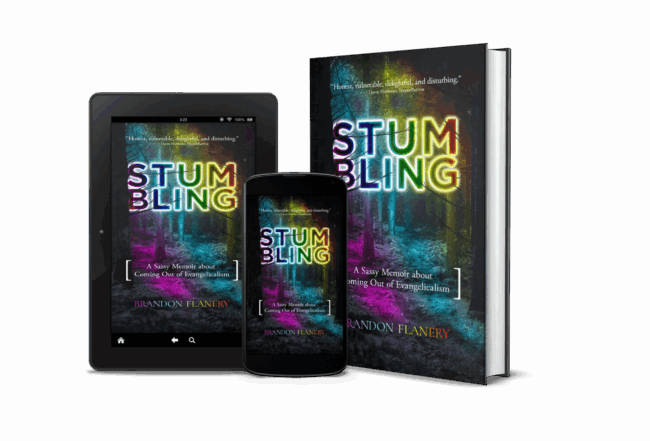
This blog post was adapted with artificial intelligence and in Brandon’s voice by Lake Drive Books from Stumbling: A Sassy Memoir about Coming Out of Evangelicalism.
Above photo by Kelly.

Brandon Flanery is an ex-pastor, ex-missionary, ex-evangelical who writes about the tenuous intersection of faith and sexuality. He’s the author of Stumbling: A Sassy Memoir about Coming Out of Evangelicalism is published with The Scribe, Baptist News Global, the University of Colorado, and the Colorado Springs Indy where he won first place with the Society of Professional Journalists. In addition to being an LGBTQ author, he co-founded the LGBTQ Christian dating app—believr—and lives in Atlanta.