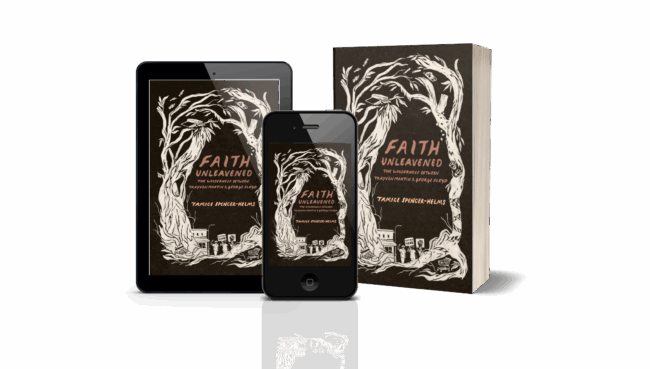
Tamice Spencer-Helms, nonprofit leader and public theologian, once gave themself wholly to white Christian ministry, trusting its promises. But when brutality against Black lives demanded a moral reckoning, the same faith community they had passionately served betrayed them with silence, excuses, and complicity. What they had thought was the gospel revealed, was instead an idol—an insidious, unlivable theology that nearly destroyed their faith.
Faith Unleavened confronts this crisis head-on. Through unforgettable storytelling, Spencer-Helms uncovers how the idol of whiteness seeps into churches, distorts scripture, and shackles the power of truth-telling. Tamice recalls the gut-punch of watching murders from Trayvon Martin to George Floyd, the numbing repetition of “thoughts and prayers,” the gaslighting when justice was demanded, and the silences that spoke louder than sermons.
But this book is more than a critique—it is a pathway toward freedom. By “extracting the leaven” of white supremacy that animates American Christianity, Spencer-Helms names the spiritual harm done when churches excuse injustice and when colonized faith tells believers to shrink themselves.
Enjoy this excerpt from Tamice Spencer-Helms' "Faith Unleavened," available from Lake Drive Books.
"Black on my Own Time, Woke on My Own Dime," from FAITH UNLEAVENED by Tamice Spencer-Helms
I moved away from the ministry in Missouri thirteen months after Trayvon died. In the wake of the burgeoning Black Lives Matter movement, I wanted to be around people who felt the same pain and outrage as I did. I was done ignoring and abhorring my Blackness. I was suffocating, and the only thing I knew to do was start over in the Blackest place I could think of. So, in 2013, I began looking for jobs in Atlanta. The white ministry I joined in college was looking for a campus minister at an HBCU there. Despite my lingering reservations about white evangelicalism, it felt like my ticket out of Missouri.
I loved the job, and I loved my students. I was finally able to embrace Blackness and incorporate it into my discipleship and theirs. We talked openly about systems of injustice, and how BLM was an outlet for their raw emotions. I was finally embracing my race as a gift, and helping students do the same. I wanted them to recognize and own all that came with being Black: the fun, the pain, and the beauty. My goal was to help them understand it was impossible for us to be unapologetically Christian without being unapologetically Black. The two informed and influenced one another. I was convinced that we could not know the beauty of being Black unless we conversed with the one who chose our heritage for us. Neither could we authentically engage with truth without bringing our ethnic identities and cultural contexts to bear upon it. That first year of work and ministry was rewarding.
Then in 2014, a year after I arrived, Ferguson, Missouri went up in flames. My students were in tears, and the campus was filled with protests. Although my white ministry organization asked me to lead some of the campus demonstrations, I quickly realized that a mere geographical change had not been enough to liberate me from the leaven.
I kept having meetings about everything on the news with distraught students and I was doing my best to point them toward a Jesus who could help them, see them, and hear them. But it got harder and harder to do as I started to feel numb myself. The bodies and the brutality were too much. It took a toll on me.
That November, my regional ministry colleagues gathered for our annual planning conference. None of the white staff could tell that I was numb. We were in a Confederate state. We passed Confederate flags on the way to and from the mountaintop retreat location where we were expected to meet with God. The other Black staff and I were on edge that year because the grand jury were set to announce whether Officer Darren Wilson would be indicted for the murder of Michael Brown. We sat in the lobby of one of the retreat center buildings around a table waiting for the verdict. Finally, the moment came.
Officer Wilson was not going to face accountability.
At the exact moment of the announcement, the conference’s director came out of the main meeting room to the table where all the Black staff were gathered. He stood directly in front of the TV and asked what was taking us so long to come join the team-building karaoke contest.
Whiteness always asserts that its priorities are more important than any other, no matter how trivial. Nothing was going to get in the way of the team-building exercise. Why couldn’t we just close our eyes and participate? Why couldn’t we be good sports? I was being expected in that moment to compartmentalize my Blackness and downplay the reality of what had just happened so that everyone could sing karaoke in peace.
I could weep for Michael Brown on my own time.
Yes, I had moved to Atlanta and surrounded myself with people who had skin like mine. But it took a minute to really start extracting the toxic whiteness in my worldview. I began to realize that all I was doing was trying to convince Black students that White Jesus loved them and didn’t hate their Blackness, but that wasn’t true. He did. He had no tolerance for who they were and never would. White Jesus cannot coexist with God or salvation any more than you can actually unleaven a loaf of bread. I was asking my Black students to try to eat around the poison because that’s what I was doing. I was afraid to admit that the whole thing was putrid. I had only ever seen evangelical ministries center whiteness. I still thought it was the only food available, and I didn’t want to starve. But I was starving in so many ways, and so were my students.
Black people’s interests were not important unless they aligned with the ministry’s. I was allowed to raise money to provide scholarships for Black students to attend the retreats at the tops of mountains lined with Confederate flags. But I was watching so many of them deal with unexpected financial challenges and family crises, and I couldn’t raise money for that. I grew
tired of helping students move out of their dorms because they couldn’t afford the room and board anymore. What they wanted more than a retreat was to stay in school. Some of them were the very first in their families to go to college, but the disproportionate challenges they faced made it harder for them to finish.
So, in 2018 I decided to stop playing the middle. I left Atlanta and started my own nonprofit, a ministry dedicated to centering Black and marginalized college students, eradicating the barriers they face. My students helped me name it: Sub:Culture Incorporated. A subculture has interests at odds with the dominant culture. I had been offering students good news that was theoretical—White Jesus’ strictly spiritual salvation. I wanted to offer students tangible demonstrations of God’s love in a way that spoke to the value of their material lives. I did not want roadblocks to become dead ends for Black students living in a racialized world. White Jesus lived in harmony with antiblackness, and therefore could not love my students.
They needed to meet the God who sees them, just like I did.
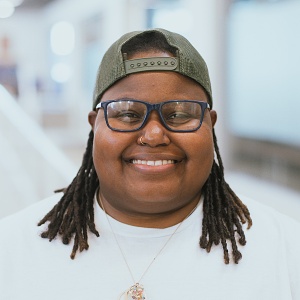
Tamice Spencer-Helms (they/she) is the founder of The Black Modern Mystic, a theo-activist, speaker, pastor, and scholar-practitioner based in Richmond, Virginia. With two master’s degrees in theology and leadership and a doctorate in Social Transformation, Tamice’s work merges spiritual practice, cultural critique, and liberative theology. They lead public speaking, workshops, retreats, and spiritual direction rooted in womanist thought, soulful leadership, and queer liberation. Tamice is also the author of Faith Unleavened, a manifesto for those reimagining the sacred on their own terms. Follow Tamice on their Subtack: tamicenamaespeaks.substack.com.