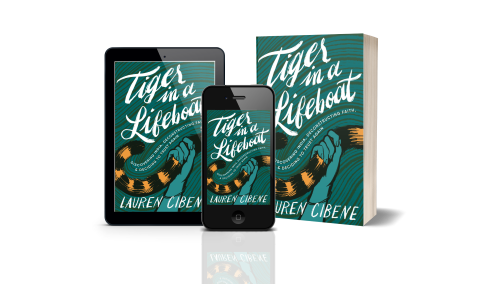
In Tiger in a Lifeboat, Lauren Cibene takes us on a deeply personal and courageous journey: when everything she once trusted and believed in fell apart, she booked a one-way ticket to India. What begins as a work trip becomes something much greater — a pilgrimage into her own heart. Through anxiety, grief, and loss, she walks through chaotic markets, sacred rivers, and unexpected friendships, slowly rediscovering who she is. The below adapted excerpt is a reclamation of self-trust, faith, and hope in a world that often strips those things away.
* * *
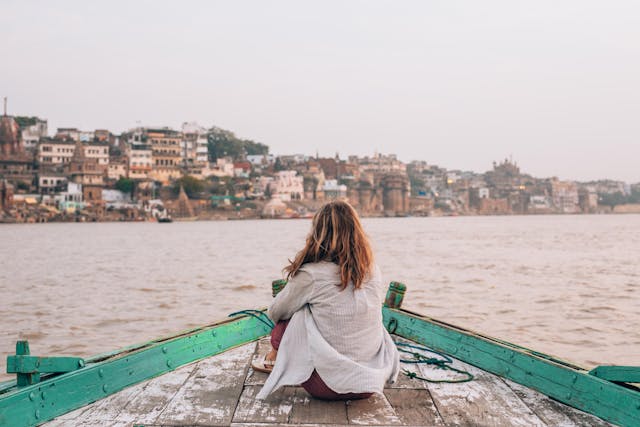
Our group makes its way through the crowds and back into the oldest part of Varanasi, the part that sidles up alongside the Ganges. Our group follows Adnan down to the very lip of the water and boards a sun-bleached wooden boat. Every night on the Ganges’ shores there is a massive ceremony for the deceased Hindus who were cremated that day. It’s why we’ve come back in the relative cool of the evening: we’re attending.
Viewing the shore from the middle of the river, we can better see the enormous ghats and riverside palaces built centuries ago by wealthy or royal Hindus in preparation for their deaths. We can also see smaller cremation fires blazing onshore for those who could not (or didn’t want to) be cremated on the official pyres we saw earlier. Our boat reaches the ceremony site and joins dozens of others filled with mourners. They pack together so closely that kids selling postcards, hot chai, and cold water can walk across one and step onto the next in the dark. The air smells like smoke and as the holy men begin performing the rites.
I notice two Indian women staring at me from the boat just in front ours. Their bodies are turned in toward each other, faces fixed on me. On the first night in Kathmandu, Adnan had warned our group that people would stare at us, ask for selfies with us, even thrust their babies into our arms, this last motivated by a charming mix of parental pride, warm hospitality, and a hope that a fascinating foreigner might bring their child a little good luck. He was right, but I’m still not quite used to it. I meet the women’s gaze a few times and quickly look away. They keep staring.
Ever since the things that broke me happened, I greatly feared intimacy with anyone. Sometimes even eye contact felt like a dangerous level of closeness to me. I felt that my trauma story was somehow spelled out in my eyes, and all it would take for someone to discover it would be for them to look at me long enough. Then they’d know. They would see my failure, my humiliation, my inability to recover . . .
And I couldn’t take any more outside input. I’d opened up a few times to people around me, and I feared that if I dared to let myself be seen again, if I put down my guard and let my eyes speak, I’d just get more of the same dismissive, bumper-sticker answers that were so abrasive to my raw soul.
So I hid behind my lashes while I spoke to people. I would pick at my nails. I would check my phone. Only when other people were speaking, when their attentions were on themselves and their own words, would I meet their eyes. It was the smallest scrap of control, the most I could find in a season where I felt very much out of control, and I seized it.
My eye contact aversion wasn’t only rooted in self-preservation and control. My soul had become a Pandora’s box of dark thoughts and messy emotions all tumbling over themselves: deep grief melded with jaded doubt and despair, punctuated by frenetic anxiety and panic, and sustained by an ever-present undercurrent of molten rage. In the words of Chris Mc Geown, “There were two reasons I was scared to let people in; the damage they could do, and the damage they could find.” I feared that if I opened the floodgates to those closest to me, I might explode all over them, unintentionally making them feel like the target of my anguish. Worse, I worried I would pull them down with me. I remembered Sunday school lessons that likened doubt to a weed, an insidious, invasive species that would choke out the lovelier plants if given the tiniest toehold, and I would rather suffer a dozen times over than plant the seeds of doubt and despair in the heart of someone I cared about. This is an experience I wish on no one.
With those unhelpful ideas from Sunday school thrown in, I was further isolated from my anxiety. I locked myself away. And in locking myself away, it became very difficult to be a good wife, friend, sister, human.
I would learn how to overcome this. It would take years, but I would relearn how to look someone in the eye and own the space I took up. To root myself in the moment. Eventually I would chronicle this story for others. For you. But there was work I had to do first.
Because intimacy is vulnerability. It takes tremendous courage to show up and be available to those around you, just as you are. You risk rejection. You risk being snubbed. You risk being misunderstood. You risk being judged and being shamed.
These are significant risks. Maybe that’s the whole point of Jesus. Even with all my complicated emotions and conflicted perceptions about God, I can’t help but like that Nazarene carpenter who showed up under the banner of “God with us.”
Not God omniscient.
Not God omnipotent.
Not God of the megachurches and prosperity gospel and GOP.
Just . . . with us. Present. Here. Together.
As I float on the Ganges, the holy Hindu men and the chaiwallahs (tea sellers) shouting their respective chants, I risk one more glance at the two women in front of me.
They are still staring, bold and unblinking.
We meet each other’s gaze, but I don’t look away this time. I anchor myself to the moment and try to just . . . be here. Open and present. I risk a smile and a small head wobble.
Both their faces blossom into big warm smiles, earnest head wobbles back. They bring their hands in prayer position to their foreheads and bow in my direction. The physical gesture of namaste. Translated literally, it means, “I acknowledge the divinity within you.”
Intimacy requires significant risk, but this great risk creates the space needed for great gain. To be seen as you are and be received into the arms of humanity—this is one of the most divine, “of God” experiences.
If God is there and if God is good, then surely God has given us to one another. And what a magnificent, terrifying, overwhelming, complicated, beautiful gift.
I feel, at this moment on the Ganges, that these two women sitting in a sun-bleached rowboat are ambassadors. They are simply watching me, as the universe watches each of us, their eyes asking: Are you going to keep looking at your shoes, arrested by the thought of risk? Afraid to see and be seen?
I hope you look up, frightening as it may be. I hope you see the divinity inside yourself and your fellow humans. And I hope you let yourself be seen, because you are enough, just as you are. Even in your struggle and your becoming. You are enough.
We are waiting for you.
Before our boat returns to shore, my husband Tim and I light small candles held afloat in bowls made of sal leaves and release them, with a prayer, into the ripples of the Ganges.

Lauren Cibene is a doubtful-yet-hopeful Jesus person, gym rat, bookworm, writer, and author of Tiger in a Lifeboat: Discovering India, Deconstructing Faith, and Deciding to Trust Again. She used to be a confident evangelical, a homeschool student, a foster mom, a world traveler, a professional photographer. Now she’s a business co-owner and daylights as a conversion copywriter, penning words even non-readers read—descriptions on product packaging and Amazon pages—but she moonlights over on Substack. She lives with her husband near Atlanta.