
“Damn.”
The word slipped out in a whisper as I sat on the old, worn couch in the corner of my therapist’s office. My world had come unraveled. Not because I cursed, but because of the words I muttered right before that. “I’m transgender.”
On the surface, I didn’t trust the words I said, but deep in my gut, I knew they were true.
Needing to be able to trust your own emotions and your own body is a theme in the life of many transgender people, including me. And not being able to trust or acknowledge your own emotions and your own body is a theme in the life of many Christians, including me. As someone who now identified both as a Christian and trans, not trusting my emotions and body was clearly a problem.
Then, my therapist started saying things to me like, “Answer that question again, but pretend there is no one judging you for your answer.” What this did was help me to understand that the little worth I thought I had built for myself was all contingent on how other people saw me, and none of it was intrinsic to my personhood. Yowch.
“Wait, what — self-worth? How do I get self-worth? You can have self-worth WITHOUT RELYING ON ANYONE ELSE TO GIVE IT TO YOU?!”
As I answered her question, I got glimpses of my newfound discovery. There were a few things on that list that smelled like self-worth.
I am good at the core. I am thoughtful. I am humorous. I deserve love. I am a trusted colleague. My emotions can be trusted.
But that voice in the background from my evangelical Christian upbringing got louder and louder, “This is why we told you not to trust therapists. They can’t be trusted. You can’t trust yourself. You know that. Why would you even want to trust yourself? You’re worthless.”
When Church Teaches You Not to Trust Yourself
Leaders at church told us all about the slippery slope, which was meant to scare us away from small sins. Each slippery-slope metaphor was full of half-truths and major consequences. But if we did exactly as we were told, followed all the rules, we would be fine.
There were many rules. Most of them were don’t rules, with a few dos sprinkled in for good measure.
Don’t curse. Don’t lie. Don’t cheat. But also: Don’t trust yourself. Don’t have emotions.
Oh dear, I’m toast.
I didn’t realize how much those last two were ingrained inside me. Deep, deep ruts — so deep they seemed like they were permanent structures until I went to therapy.
Before coming out to my parents, I had found an actual therapist, who happened to be Christian, yet who also helped me realize that there was no sin that needed to come to light. Instead, what I needed to understand was my worth.
Once I started to realize that my own worth was buried at the bottom of that slippery slope, it started to come together. To get to it, though, I had to get through all the bullshit the church had piled onto it. I had to get underneath it all to my essence.
I went to therapy, and I had to dig. And oh, did I dig. I had to remember and think and sort through my expressive charismatic upbringing. My therapist helped me re-experience my past experiences through EMDR therapy. I had to dig through all the scripture repetition that, looking back, was designed to bury emotions and self-perception until I no longer existed through my own will, and instead, I was only the layers of religion that surrounded me. In fact, I now understand that my descent on the slippery slope wasn’t because I fell and slid down. I actually couldn’t even get past the gates that led down to the slope. They were locked tight, so instead I dug down. Some would say I’ve dug all the way to the bottom, the place where the devil himself resides. I would say it’s simply a place where I can feel. I can now move from my head to my body and really feel.
Once I started to feel, I realized very quickly that self-worth wasn’t just going to spring to life and help me understand who I was. It was a heavy burden that couldn’t be unloaded in one therapy session. A notion and feeling of worthlessness is a burden I have carried since I was a small child, and it crushed every part of me.
From the earliest age, I can remember wanting so badly to pass the test as a Christian but knowing I never could. I came home from church camp, broke all my CDs that had any curse words in them, and sold the rest to Sam Goody. I still have a twinge of guilt for keeping my Matchbox Twenty CD.
Every year I tried to be a better Christian, like going to a carnival and the worker there telling me had to spend the money to try again. Each time I would win, they would say, “Sorry, kid, that’s just the small one, try again!” The problem was, I couldn’t leave the carnival. Through it all, I soon figured out that I didn’t matter. Not life didn’t matter, but I didn’t matter. A meaninglessness that still rears its head from time to time.
Through this burden of self-flagellation and self-hatred, I came to inhabit worthlessness. I remember an image they would teach at our Christian school to convey the concept of eternity. They would tell our fifth grade, yo-yo-playing-at-recess minds metaphors like this: Imagine the earth made of brass. And imagine a dove flies by the earth, every thousand years, and brushes the earth with its wings. Now imagine when that brass ball is ground into dust. That is the beginning of eternity. Failure was not an option.
Stepping back, I realize now that I can attribute most of my feelings of worthlessness to religion. But religion isn’t a thing in and of itself. It takes people to be the face of a religion and make things happen. And when good people are told they’re worthless, deserving of the worst hell imaginable, they can’t help but pass that along to others.
A community that incorporates systemic worthlessness overpowers even the most charmed, privileged daily life, wrestling away the thing that it needs most, unconditional love, replacing it with shame.
From Worthless to Whole
On some level I knew that I was transgender growing up. But when I was young, knowing myself fully beneath the pile of worthlessness and shame was more out of reach than I could have possibly realized.
As a kid and young adult, I felt like I didn’t matter, so why even get to know who I was? So I stuck to my outside, cleaning my surface If I dug beneath, it could get ugly.
So, I was content. Content to know that I didn’t really know the full story of myself. Letting worthlessness drive the car to keep me hidden. I learned recently that the game Chutes and Ladders is a Hindu game of virtue and Karma. And I now understand why I liked the chutes better than the ladders. Perfection is hard, and we can learn so much about ourselves from sliding down the slippery slope.
As I discovered more of myself, I no longer wanted to be perfect and get to the top. I slowly was desiring to get to the bottom of myself. And in doing so, I realized that worthlessness was the overarching theme of my life. For most of us, worthlessness can’t exist in a small corner of our being. Instead, it’s something that gets into our small cracks and crevices and spreads. Like water, it fills up our empty spaces. And when we don’t know ourselves there are a lot of empty spaces to fill up.
Realizing I had a problem with feeling like I was worthless was just the beginning, though, of a process of naming who I am, telling others, and continuing the process of understanding what that means every day.
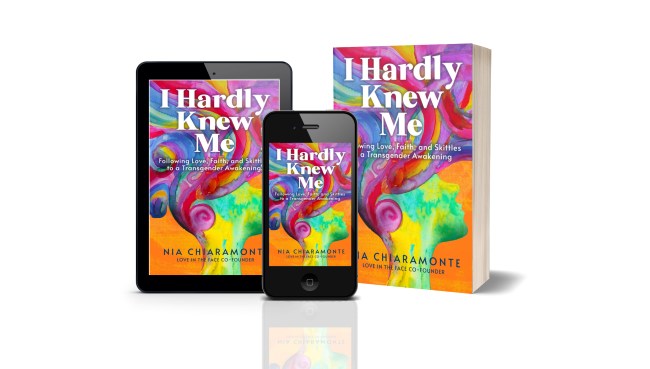
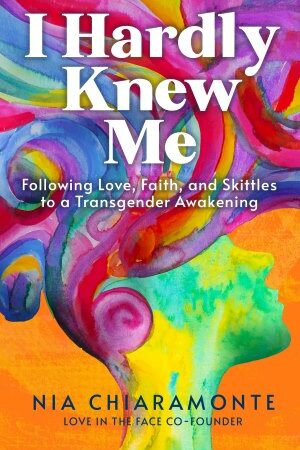
This excerpt from I Hardly Knew Me: Following Love, Faith, and Skittles to a Transgender Awakening by Nia Chiaramonte, Founder of Love in the Face is adapted with permission. Photo above by SHVETS production.

Nia Chiaramonte, with her wife Katie J. Chiaramonte, is the co-founder of Love in the Face (loveintheface.com) and co-author of Embracing Queer Family: Learning to Live Authentically in Our Families and Communities. Nia and Katie work to support other transgender and LGBTQIA+ individuals and their families on their journeys of self-discovery. She and Katie were featured in the Hulu documentary We Live Here: The Midwest. Nia is a nonprofit professional and she and Katie reside near Baltimore, Maryland with their five children.