
Back in 2010, Becky Garrison published Jesus Died for This?, a satirical deep dive into the bloated, bedazzled body of American Christianity. The subtitle—A Satirist’s Search for the Risen Christ—wasn’t just clever marketing; it was Garrison’s last-ditch spiritual GPS attempt to locate the divine among the ruins of the Christian Industrial Complex. She didn’t expect to find Jesus in a megachurch green room or hidden behind a conference hashtag—but she had to check, didn’t she?
Now, Jesus Died for This? is back in print, and as Garrison and I recently discussed (see video below), not only is this book still painfully relevant, but the religious circus has somehow added a few more tents and is now charging extra for the popcorn.
Let’s get one thing straight: Garrison didn’t write this book as some disgruntled ex-evangelical trying to blow up the church on her way out the door. She was trying—desperately—to find something sacred amidst the spiritual clutter. What she found looked less like the risen Christ and more like a marketing department that mistook WWJD bracelets for actual theology.

Jesus, Interrupted (By Product Placement)
The book might as well have been subtitled “Pilgrimage to the Prosperity Gospel,” because everywhere she turned—whether in Israel, Jordan, or down the aisle of a Christian bookstore—she encountered commodified holiness. Holy Land baptism robes, blessed bottle openers, an entire aisle of “spiritual” junk that made Spencer Gifts look like a monastery. It wasn’t just Jesus they were selling—it was a whole prepackaged lifestyle, the kind that comes with a free T-shirt if you tithe on time.
At the time, publishers pitched Garrison as the next Mike Yaconelli, some “hip” Christian voice meant to slap a snarky veneer on an otherwise toxic theology. What they didn’t realize was that she wasn’t here to repackage the gospel in skinny jeans and ironic Lent devotionals. She was here to expose the hollow core of a religion that had traded prophecy for platform and Eucharist for Instagrammable communion sets.
Let’s call it what it is: faith-flavored capitalism.
Welcome to the Holy Hipster Hunger Games
There’s something almost tragically comedic about the spectacle of Christian conferences competing over which ex-pastor-turned-podcast-host has the hottest take on deconstruction. Throw in some recycled Henri Nouwen quotes, a candlelit Taizé playlist, and boom—you’ve got yourself a New Kind of Christian™ starter kit.
The emerging church movement—oh how they loved that label—tried to pretend they could save the institution by rebranding it. Turns out, all they did was put beard oil on a corpse. Conferences became the new cathedrals, and bestselling authors the new bishops, all while the pews quietly emptied. The publicists called the shots, not the prophets. And the only thing “missional” about the whole setup was its mission to sell books and build brands.
Remember Rob Bell? Back in the day, people freaked out when he started asking theological questions that didn’t end with a six-point altar call. If he was considered too liberal, Garrison knew there was no room left for satirists like her. The Christian publishing world had no idea what to do with someone who preferred satire to sanctimony.
When the Church Went Full QVC
The “accidental pilgrimages” Garrison documented in her book started in the Holy Land and ended in America’s own religious theme parks. She visited the “Christian casinos” in Las Vegas, the Disneyland-for-Jesus vibes of the TBN Holy Land Experience, and pastors who spent more time managing brand identity than feeding the poor.
She went to Jerusalem expecting spiritual transcendence and got an Orthodox turf war over who owns Jesus’ tomb. She walked the Via Dolorosa behind a group of tourists wheeling plastic crosses and posing for selfies at the stations of the cross. If Jesus did rise from the dead, it’s probably because he needed to escape the merch table.
In Nazareth, she met a sanitized Jesus who looked like a Malibu Ken doll with highlights. This wasn’t the brown-skinned, rabble-rousing peasant who flipped temple tables. This was Blonde Jesus™, available now in three skin tones and two denominational styles.
From Holy Land to Hipsterland
Eventually, Garrison found herself in the Pacific Northwest, far from the Bible Belt and even farther from the Christian Industrial Complex. Out there, people commune over craft beer, biodynamic wine, and—gasp—actual conversation. No $350 church growth seminars. No “holy hipster” influencers trying to sell the latest devotional-slash-journal-slash-merch-drop.
In our conversation, she pointed out that the Pacific Northwest is isolated enough to grow something organic. You can’t sell snake oil when nobody’s buying. You want to talk about the theology of fermentation? Grab a cider and pull up a barstool. There’s room for you here, Zoroastrian viticulture and all.
Because what she eventually discovered is that community doesn’t need a platform. It needs presence. Spirituality doesn’t need branding. It needs belonging.
Cassandra at the Conference Table
Sometimes people call Garrison Cassandra—yes, the Greek myth version, cursed to tell the truth but never be believed. When Jesus Died for This? first came out, her warnings were ignored. Nobody wanted to hear that the emperor had no theological clothes. But now? The whispers she heard—about abuse, narcissism, cover-ups—have turned into a roar. Hashtag #ChurchToo is only the beginning.
She didn’t want to be right. She wanted the church to change.
Instead, people clung to systems built on patriarchy, celebrity, and consumerism. They propped up narcissists with book deals and built megachurches on moral quicksand. They thought they could curate a better church, market it, and call it holy. Spoiler: Jesus doesn’t follow your brand guidelines.
But Is There Hope?
We’re watching institutions collapse and trying to duct tape the ruins with TikTok theology. But maybe, just maybe, that’s not the worst thing. As Margaret Wheatley puts it, we’re living through the end of a civilization cycle. Institutions are failing. New forms are emerging.
So if you’re tired of being marketed to, if you’ve been burned by the church and branded as a doubter, Garrison raises her glass to you. There’s another way—less polished, more painful, but real. The divine is still out there, but you’ll probably find it among the misfits, the marginal, the ordinary radicals who are too busy feeding people to post about it.
We don’t need another guru. We need grace. We don’t need more merch. We need mercy.
As for Garrison? You’ll find her at the local brewpub, sipping a smoky single malt, talking to a former nun and a pagan beekeeper about what it means to really follow Jesus. Not the brand. The person.
So, yeah. Jesus died for this. But maybe, just maybe, he rose for something better.
Cheers.
Adapted with permission with the help of ChatGPT from Jesus Died for This? A Satirist’s Search for the Risen Christ.
Photo by Gift Habeshaw on Unsplash

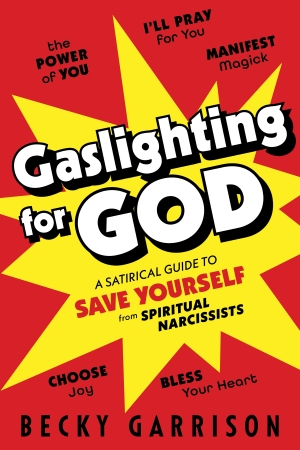
As a religious satirist, Becky Garrison served as Senior Contributing Editor for The Wittenburg Door from 1994 to 2008, and has been on its board of directors since its relaunch in 2021. She’s the author of eleven books, including Gaslighting for God: A Satirical Guide to Save Yourself from Spiritual Narcissists and Distilled in Washington: A History. Also, she co-edited a book of love letters penned by partners of trans folks to their loved ones, as well as contributing chapters to about a dozen other books. She lives in the Pacific Northwest, where she covers the region’s craft culture, including cider, beer, wine, spirits, cannabis/CBD, psychedelics, and the regional festival scene. Follow Becky on Substack here.