
Buy Here: Bookshop | Amazon | Lake Drive | Barnes & Noble | Books-A-Million | Apple | Google Play
Faith Unleavened (Excerpt)
The Wilderness Between Trayvon Martin & George Floyd
Tamice Spencer-Helms
Table of Contents
Prologue
I: PART ONE
Walking Back
Eat This Bread
I Met White Jesus in Hell
Buttered Rolls and Peppermints
II: PART TWO
Lessons from the Levees
Pendulums & Paradigms
Missouri Compromise
Can We, Though?
White Sheets and Black Stories
Discomposure
III: PART THREE
White Jesus: An Origin Story
Sidewalks
Stolen Election
IV: PART FOUR
Black On My Own Time, Woke on My Own Dime
The Naughty List
Get the Memo?
V: PART FIVE
They Called It Love
Shopping Carts
Flying
Birth and Rebirth
Downhill From Here
VI: PART SIX
Fear Goes First
Wild
Scars and Tables
Epilogue: The Crucifixion of George Floyd
Acknowledgements
The Land
Author Biography
Prologue
When they flipped his body over, the bright canary yellow blanket fell on the grass. His hoodie was damp because he’d been laying there a while, and it had been raining that night. He was wearing jeans and fresh Fusion Force 20s. The red, black, and white ones with the red strap and patterned flap. I recognized those Jordans because my brother has a pair. His fade was cut the same and his skin was a darkened caramel color too. It could have been my brother under that sheet. His 7-Eleven lighter along with the Skittles he’d bought his little brother were strewn on the lawn, and they found the AriZona iced tea a little bit later.1
I didn’t sleep that night. I kept thinking about the shoes.
That Sunday when I went to church, we sang happy songs about God’s goodness and glorious reign. No one talked about Trayvon, not even the pastor. We learned about joy and gladness the week the 911 recordings came out, and we prayed for revival in America during the rallies in Sanford, Florida.
In November of the same year Trayvon died, Jordan Davis was shot to death because a white man thought his music was too loud,2 and Rekia Boyd was shot in the head while standing with some friends. The off-duty officer carelessly fired shots over his shoulder into the group because he thought her friend’s cell phone was a gun.3 At church the day after the jury acquitted Trayvon’s killer, they talked about how sad it was that the guy from Glee died. They didn’t know anything about Trayvon. They didn’t even know his name.
I felt a deep and nauseous sadness that grew more and more unbearable. I told my friends, but they didn’t understand why I would be so upset about some “thug” in Florida being in the wrong place at the wrong time. Or why I was concerned about how many white people were on the jury of that other trial I’d been telling them about—the one where the boy stole the Snickers and died.
“His name was Trayvon, and he didn’t steal,” I told them. I didn’t tell them about my brother, and I didn’t tell them about his shoes. They didn’t deserve to know.
Four months later, in the middle of the night, Renisha McBride was shot in the face with a 12-gauge pistol-grip Mossberg shotgun through a screen door on her neighbor’s porch because she was knocking too loudly.4 Eight months after that, in New York, Eric Garner was choked to death in broad daylight for selling individual Newport Kings that weren’t in their original packaging5—the kind Rigby, my auntie, used to smoke. She called them “loosies.” Eric told the officer he could not breathe, but it didn’t matter.
In Ohio one month later, John Crawford was shot inside a Walmart for picking up a gun they sold in the store while his girlfriend gathered ingredients to make s’mores.6 Michael Brown was shot six times and left lying face down in Ferguson, Mo., in August in the middle of the road. The officer let his body fry on the asphalt of his neighborhood for four hours in front of his mother’s house.7 Two days after that, Ezell Ford was shot in the back at close range. The officers who killed Ezell said they stopped him for “walking on the sidewalk at 65th Street.”8 Two months after that, Laquan McDonald was shot 16 times in 13 seconds. The officer said he was afraid for his life because of the folded pocketknife in Laquan’s pocket.9 The next month, a 12-year-old boy was shot in the torso for playing with a toy gun in the park.10 He died the next day. His name was Tamir Rice. In April of the next year, Freddie Gray’s spinal cord was snapped in half while he was being transported by police for possessing what they referred to as an illegal switchblade; they didn’t buckle him in when they drove him away.11 In November, Jamar Clark was shot in the head while handcuffed,12 and Akai Gurley was shot to death while walking down the stairs.13 Walter Scott was shot dead in the back by an officer who lied in his report.14 Just across the border of that town, only two months later, nine Black men and women were massacred in their own church during Bible study.15
Alton Sterling was selling CDs out of his trunk at a corner store in Baton Rouge when he was pinned to the ground and shot five times in the chest at close range.16And the very next day, the entire world watched live as Philando Castile bled to death in front of his 4-year-old daughter and his girlfriend. He was shot seven times while sitting in the passenger seat. He was wearing his seatbelt.17
But still the pastor didn’t say anything.
“Numb” is not the right word because it was sharper than that. “Angry” won’t suffice either because it was deeper. It was as if the world was spinning, and I could not find my balance. With every hashtag, the crack in the toxic foundations of my faith grew wider. Where do you run when the only person you can turn to is White Jesus? I could not breathe. I could not sing another damn song about joy. I didn’t know it then, but I was fellowshipping with the 81% of white evangelicals who voted for Donald Trump, and there was leaven in the bread.18 How could they be so oblivious to the issue at hand? How could they not see it? Why did they argue with me so much about it? Why did I have to calm down?
They were convinced all those who had been killed had done something wrong, something to deserve being gunned down like beasts with no family, no future, and no dignity. Why were all the pictures of the slain so dark and thuggish? Why were all the murderers in uniforms and family photos?
The anguish was unbearable. It was the culmination of so many things I’d ignored for so many years. How many Black bodies had to drop before they cared? Didn’t Jesus care? Why didn’t they know any of their names? And why did all the GoFundMe money go toward George Zimmerman’s bail instead of Trayvon’s burial? Deep inside I knew something was happening to me, and I knew it was the beginning of the end. Of what? I didn’t know. I hoped it wasn’t my faith, but I didn’t have the energy to fight it. I couldn’t see Jesus through the pile of dead Black bodies anyway. I spent the three years after Trayvon died in perpetual despair.
It felt like there was trauma in my bones. Like I was carrying the pain and the weight of the entire struggle for freedom and dignity, and I couldn’t decide if I wanted to be free. At the same time, this pain gave me a sort of strength, and it began to lift me. Right as it did, Donald J. Trump was coming down an escalator to announce his run for the presidency.
And I began seeing red.
Trayvon Martin, his shoes, and the trial of George Zimmerman were responsible for the beginning of my exodus from toxic, white Christianity. Before that, my peers in the white churches I attended routed their racist attitudes through religious beliefs and backed them with biblical authority, which made them harder for me to detect or resist. But when Trayvon died, it was the straw that broke the camel’s back. Religion was no longer an adequate obfuscation. George Zimmerman’s story just didn’t add up.
Initially, Zimmerman saw Trayvon walking through a gated community and began following because he thought Trayvon seemed suspicious. Zimmerman followed in his car, and then on foot when Trayvon turned off the sidewalk to go through a backyard. Zimmerman even ignored police who told him to leave the teenager alone and let them handle it.19 Acting as self-appointed gatekeeper that night, he saw a young Black boy and thought, “Intruder.” Trayvon was 17, unarmed, and minding his own business.
My friends didn’t budge when I tried to talk to them about it. It was sad, they told me, but I needed to trust that Jesus was on the throne and remind myself what Paul said in Romans 13 about respecting authority. But what was dangerous about a boy in a hoodie? What is threatening about a bag of candy? What authority did Zimmerman carry? Even still, they were positive they were not racists. How could they be, when they were friends with me? They were just being objective, radical for the truth, swayed only by facts.
I reeled as the list of hashtags grew and the people around me did not. Jesus couldn’t be this cold and unfeeling. There had to be a way to love both God and my neighbor with a clear conscience and common sense. It had to be possible to love and follow Jesus in a way that would let me sleep at night. There had to be an answer for the carnage and something stronger than the rage. There had to be a way to love the Lord and breathe. I could not breathe. I didn’t need Jesus to be on the throne, I needed Jesus to come down here. I could no longer worship a god whose love couldn’t break through yellow caution tape. I could not negotiate any longer with a god who could not meet me on blood-soaked asphalt next to shell casings, evidence markers, and white chalk. But I did not know where to find that God. At the same time, I had the gross realization that my only purpose in the lives of some of my colleagues in ministry was to sanction their racist attitudes with my silence born of self-preservation. I held my tongue in the name of unity among believers, but they never held theirs. They made ignorant and infuriating comments without any hesitation or care for the ways their opinions did violence to my soul. I fell into a deep depression and began to let tequila do the work that the Spirit once did.
The murders of Trayvon Martin and George Floyd took place at either end of a number of messy, painful, glorious, beautiful, and liberative things that happened in my life and theology, which are the focus of this book. Trayvon’s death caused the upheaval of everything I knew and believed. As everything came crashing down around me, I was left with mere fragments of the faith that had motivated every major decision I’d made up to that point.
The devastation defined me for a time and led me into a dark and lonely place until the silence from God broke one day in 2015. That word from God gave me the courage and permission I needed to begin extracting the poison from the Christianity I had adopted. If Jesus was the bread of life, then there was something else making me sick and I needed to figure out what it was. I learned it wasn’t the bread; it was the leaven of whiteness.
May 25, 2020, the day a police officer murdered George Floyd, was a wake-up call for a lot of white people, but I couldn’t at that point call any of them friends. I’d lost so many of them along the wayside of the acquittals and non-indictments in the years that followed Trayvon’s death. By that point, I’d given up bickering over confederate flags and monuments and trying to help them recognize how atrocious their justifications for brown children in cages were. Too much had transpired, and it was too late for their apologies to have any bearing on my well-being or my tolerance for White Jesus.
I broke when George Floyd was killed, but I did not break the same. The systems hadn’t changed, but I was different, and that changed the nature of the sting. As the world witnessed the horrors and toxicity of the yeast of whiteness, I loved myself, my Blackness, and the truth enough to find refuge and solidarity in Jesus, the author and perfector of a new, unleavened faith.
Buy Here: Bookshop | Amazon | Lake Drive | Barnes & Noble | Books-A-Million | Apple | Google Play
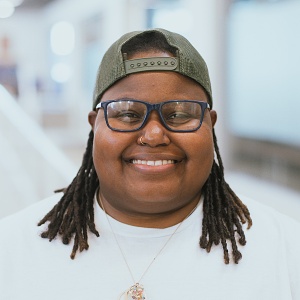
Tamice Spencer-Helms (they/she) is the founder of The Black Modern Mystic, a theo-activist, speaker, pastor, and scholar-practitioner based in Richmond, Virginia. With two master’s degrees in theology and leadership and a doctorate in Social Transformation, Tamice’s work merges spiritual practice, cultural critique, and liberative theology. They lead public speaking, workshops, retreats, and spiritual direction rooted in womanist thought, soulful leadership, and queer liberation. Tamice is also the author of Faith Unleavened, a manifesto for those reimagining the sacred on their own terms. Follow Tamice on their Subtack: tamicenamaespeaks.substack.com.

Contact
[email protected]
6757 Cascade Road SE, #162
Grand Rapids, MI 49546

As an Amazon Associate and Bookshop.org Affiliate, Lake Drive Books earns from qualifying purchases.