
Buy Here: Bookshop | Amazon | Lake Drive | Barnes & Noble | Books-A-Million | Audible | Apple | Google Play
Theologizin’ Bigger
Homilies on Living Freely and Loving Wholly
Trey Ferguson, Foreword by Candice Marie Benbow
Contents
Part I: B.I.B.L.E. (Books Inspired by Life’s Experiences)
The Very Word of God
The Bible Ain’t No Car Manual
In-House Discussions
There Is an Ark in Kentucky
Part II: The White Man’s Religion
We Don’t Do That Here
Straitjacket Faith
We Gotta Have a Talk about Deconstruction
The Truth Gon’ Set You Free
Part III: A State of Confusion
The Church Gotta Pick One
I Think We Got Shame Backwards
I Got a Dope Résumé for Grifting
Whose Gospel?
Part IV: Faith That Shapes Tomorrow
The Future Looks Different
Living in the Matrix
Anything Is a Heresy If You Try Hard Enough
Leaning into Mystery
The Rehumanization Project
Foreword
Candice Marie Benbow
The B-I-B-L-E! Yes, that’s the book for me! I stand alone on the word of God! The B-I-B-L-E! Bible!
As a kid, I sang that song in full voice—not necessarily knowing what it meant. I just knew that I was a Christian and, as a Christian, the Bible should be the only roadmap for my life. If God is the sole source of my strength, then the scriptures would teach me how to access “Him” and all “He” has for me.
And, as a kid, that made sense. Though an inquisitive child, I didn’t have a set of questions that caused me to side-eye the Bible (and the sermons preached from it). There were things that sounded strange, but at the same time I was singing that little diddy, my biggest concerns were circling everything I wanted in the Sears Christmas catalog and praying Santa would leave it all under the tree. Whether or not the Bible was the book for me would just have to wait until I was old enough to actually care.
There’s a reason why the older saints of the Black Church would say, “just keep on living.” It was their response to the ways younger folk would dismiss well-meaning advice as out of touch with the times. Essentially, they were telling us that if we were blessed enough to get a few more years under our belts, we’d see the value in exactly what they’re saying. And many of us did.
The older we got, the more life happened. And the more life happened, the more unsustainable some of the biblical and theological lessons we were taught became. Racism, sexism, homophobia, transantagonism, classism, ableism, and so many other social ills set the world on fire and continue to flame. Add to that navigating personal challenges of family dynamics, mental health concerns, imposter syndrome, relationship drama, and fighting with everything you’ve got not to become your parents and sounding like them when stuck in traffic. Life for many of us ain’t been no crystal stair. And when spiritual teachings and religious platitudes fall flat, the impetus is to walk away from it all.
Don’t get me wrong (many have). Studies show that millennials and Gen Z are less likely to have affiliations with institutional churches and are more likely to embrace spiritualities that keep “religious foolishness” at bay. Today’s deconstructionist movement aims to reclaim parts of our Christianity from the clutches of white supremacy and heteronormativity . . . which is a good thing. Yet, even as this needs to happen, I question just how invested many of the movement’s leaders are in helping to actually heal the wounds religious trauma causes and chart new paths forward.
Enter Trey.
I’ll be honest: as a Black feminist woman of faith, I’ve grown tired of hearing Black men talk about God. Partly because they were the only ones talking. Mainly because often what they said didn’t make a lick of sense. And when I was engaged in my own personal campaign to hear fewer male voices, I encountered Trey’s. I wanted to roll my eyes and ask, “Who is dude?” But I couldn’t. In the words of those older Black Church saints, he was “talking right.” Reading bell hooks, James Baldwin, and other Black writers, Trey was making the kinds of theological connections that help make faith live on the ground for everyday people.
And he is a pastor; he cares about folk in a way I hadn’t seen in quite some time. Maybe since I was a child. There are many of us who can admit that, while the theology of our childhoods is eighty-five percent of the reason we’re working through the traumas we have now, we also had pastors who really seemed to care about us back then in a way many seem too busy to care now. If we could find a way for this new generation of pastors to be more empathetic and intentional, grounded in theologies that don’t kill our spirits and dreams, then we’d be cooking with hot grease! I see that synergy in Trey.
Plus, his social media clapback game is top tier and I love anybody who doesn’t suffer fools on the apps.
When Trey told me that he was writing a book, I got excited. Admittedly, my primary concern will always be for the total liberation of my people. I thought about the many brothers who will be helped and hoped by Trey’s theologizin’. There aren’t many millennial Black men writing about God in the way Trey does. That matters, for a number of reasons. I’m not naïve enough to believe sexism is dead. I know there are many who will refuse to listen to women like me simply because we are women. And while I may believe they deserve a first-class ticket to the hottest parts of Sheol, thank God there are people who believe those guys are worth redeeming.
And attempt to redeem them, Trey does. In the book you’re about to read, Trey offers something very important. He’s taken this big and wide concept of our faith and broken it down into digestible stories that bring us back to why we fell in love with Jesus in the first place. And for those who were forced into that love during their childhoods, Trey offers opportunities to come to it on your own and discover it freely. He does not shy away from holding the institutions we’ve held dear accountable for the harm they have caused. And at the same time, he offers his work and words as a place where those same beloved institutions can begin to right their wrongs.
In this way, Trey is not only pushing us toward bigger theologies that can hold the totality of who we are. He is calling for us to embrace better theologies—theologies that fully honor our humanity and the God who fashioned us as good creations. And we are the better for it. Whether you’re still singing that biblical nursery rhyme in full voice without a care in the world, whether you haven’t picked up a Bible and stepped in a church in years, or whether you find yourself somewhere in between, Trey wrote this book with all of us in mind. We were on his heart as he penned each word with purpose and precision. This tome is a labor of love. May we reciprocate that love by coming to each page with an open mind and receptive heart.
Candice Marie Benbow is a theologian, essayist, columnist, baker, and educator whose work gives voice to Black women’s shared experiences of faith, healing, and wholeness. She is the author of Red Lip Theology: For Church Girls Who’ve Considered Tithing to the Beauty Supply Store When Sunday Morning Isn’t Enough.
Introduction
I’m a theologizer.
Some people would describe me as a theologian. I wouldn’t argue with them on that particular front. But it’s not a label I often apply to myself.
A theologian is something of a job description. People who specialize in theology or have dedicated a significant amount of time to the study of theology are often described as theologians. By most metrics, I’d fit the bill. I’ve just never been too interested in proving my bona fides on that point.
Simply put: I got a nerdy side, but not on purpose. I don’t take pride in flaunting it. I’d rather you find out about that side of me the hard way than me tell you up front I’m a nerd and risk disappointing you by not being nerdy enough.
Theologizin’ though? That’s different. To theologize is to value the art of speculation. Theologizin’ is theorizing about theological subjects. It’s to wrestle with the attributes of God and God’s relation to the uni verse and creation. It’s the pursuit of a truth you’re confident you’ll never fully capture. When you theologize, you give religious significance to the stories you share and prioritize. I can’t help it. I’m always doing that.
I first recognized I was a theologizer when I found myself turning random things into sermons in my head.
One time, I saw a spiderweb by my front door. Okay, let me fix that. I’d hate to start this book by telling half-truths. My wife found a spiderweb by my front door. She did not want that spiderweb to stay there. So she called me to do something about it. That is when I saw the spiderweb. I looked at the spiderweb and got lost in thought. I followed the thin, silky lines in the design. It was asymmetrical but still bore a beauty I struggle to describe. I thought about how this little arachnid was capable of building such a massive and intricate structure in such a short amount of time. It’s not like I didn’t use my front door several times a day. The more I thought, the more amazed I became over the fact that I simply lacked the capacity to build such a web. Sure, I only had two legs and a couple of arms (instead of the eight append ages the spider was blessed with), but I was way bigger than any spider I’d ever seen.
Yet here I was, going to work just to make money to pay bills and feed my family. And here was this spider, setting up shop in front of a house it ain’t pay no bills in. Little critters would get trapped in this web. The spider would be able to eat because of the work it did with no training or student loan debt. Just by doing what it was uniquely created to do, that spider would be able to live a whole life.
That spider was preachin’ to me.
I told my wife what I’d learned from that spider just like I told y’all. She looked at me with a blank stare and asked if I took down the web or not. That’s when I realized I was probably doing too much.
I wasn’t doing it on purpose though. I’m not even sure when it started, but the most mundane things turn into investigations. I’m always looking at the world around me and wrestling with what I learn about God and creation through these observations. I notice things and ponder past the point that most people would consider productive. I’m ascribing religious significance to all sorts of things in real time. I’m consistently filtering my religiously held beliefs through the lens of the things I experience on a day-to-day basis.
Theologizin’ is a little more active than the image that the word “theology” stirs up in the imagination. You can study theology and become an expert. But theologizin’? That’s an action. You can’t theologize without breaking a sweat.
Studying theology is usually deliberate. You can go to a school of theology and get a master of theological studies degree. I’ve been to a couple such schools. This ain’t shade against theologians. Remember, I’m a theologian too, depending on who you ask. Still, the label “theolo
gian” can seem a bit exclusive at times. And if you own the fullness of your identity in the pursuit of theology? If you just “be yourself ” as a theologian? You’re liable to get a couple labels tossed your way. If you’re doing theology as a woman? Now you’re a feminist theologian. You openly Black? You’re a Black liberation theologian. Are you a proud Black woman? You’re a womanist theologian now. Apparently the only “nor mal” theology is the kind all the white dudes in the sixteenth century did, and everything else is a derivative.
I think everybody does a lil’ theologizin’ though.
The enslaved African people who heard one gospel of submission preached to them by their enslavers but understood that the God of the Exodus was the kind of liberator who heard their plight? They were theologizers.
The European pilgrims who took that same story of the Exodus and understood that God was with them as they left the only land they’d called home and sought prosperity in the “New World”? They were the ologizin’ too.
If you believe there is an active, divine force impacting the world around you, congratulations. You been theologizin’ this whole time. Theologizin’ ain’t just for the theologians. It’s for everybody who’s still thinking thoughts about God. Good thoughts. Bad thoughts. Skep tical thoughts. Undoubting thoughts. Old thoughts. New thoughts.
When you’re willing to sit with those thoughts and follow where they lead you, I’d call you a theologizer.
I think a lot of overtly religious and religious-adjacent people have been theologizin’ since forever. It’s how we end up organizing around things like religion. Theologizers have been at the forefront of religious schisms too. And people who up and leave faith systems behind? In my experience, they usually only do that after quite a bit of strenuous theologizin’.
Theologizin’ in certain spaces can cost you a whole lot.
A lot has been made of the shifting religious landscape in recent years. The Europe that we see right now is less overtly religious than it was a few centuries ago. At the time of this writing, religious identification in the United States has been in decline for the last five decades. The fastest growing religious identification in the US is the “nones”—
people who self-identify as atheist, agnostic, or nothing in particular. I’ve got a few theories as to exactly why that is. As life (particularly in the West) has become more global, we have more access to diverging viewpoints than we’ve ever had. Some of the viewpoints and experiences we encounter are extremely difficult to reconcile with the beliefs that have been placed on the table before us. Faith communities with rigid boundaries and orthodoxies might feel unaccommodating to people who are trying to sort through their beliefs in a world that is constantly challenging their own lived experiences. Just as the printing press changed the world (both sacred and secular) in the sixteenth century, current mass-media developments are impacting the speed at which we receive and process information in ways that might’ve made the patriarchs dizzy. Also, some of the theology of the church seems irrelevant to con temporary society. Theology speaks to contexts. The work of a good theologizer is to take an inherited theology, wrestle with how it speaks to the current context, and present it in a way that honors tradition while acknowledging the current day. And some communities just don’t like that kind of work.
Some people feel forced to make a choice. Either they pretend that inevitable change is not happening around them for the sake of belonging to a community of faith, or they leave so they can lean into that change without the shame that comes from that very community when reconsidering and adjusting beliefs. Many of those people are choosing the latter. I do think there’s a difference between the things that people believe and the communities they say they find belonging in though. And that’s why this book exists.
I think there are plenty of people in religious communities who don’t fully know what they believe. They know what to say they believe. But, for the most part, they don’t live in absolute silos and are getting a lot of the same information and have a lot of the same questions.
Likewise, I think there are a lot of people who have left religious communities behind even as they hold a curiosity (and maybe even a hope!) for the Divine.
While I am not shy about the fact that I am a Christian minister, this book is not intended to be an explicit invitation to conversion or discipleship. I’m happy to walk you through what that might look like or mean for you, but that’s not what this particular book is about. This book is an invitation to theologizin’ a little differently than we may have felt was permissible.
When I speak of diverging viewpoints, faith communities with rigid boundaries, irrelevant theologies, and contemporary contexts, I’m trying to name a convergence of factors that present obstacles for theologizers. It’s easy to look at these factors and think that we have to give up theologizin’ altogether, or that we have to ignore large parts of ourselves in order to keep being theologizers.
This book is about a third option. You don’t have to ignore your nagging doubts and honest questions. You don’t have to check any part of yourself at the door. You don’t have to stop theorizing or theologizin’. You can theologize bigger.
Some Housekeeping Notes
Before I knew I was a writer, I knew I had stuff to say. And before the podcasts and newsletters, I said a lot of that stuff on social media. I was microblogging before I knew that’s what it was called. You’ll notice that every one of the chapters in this book begins with a quote. Those quotes are actual social media posts I’ve made over the years.
Before I knew myself as a theologizer, I’d been theologizin’ on the platform formerly known as Twitter. I know it’s been rebranded, but whether it’s Twitter or X or whatever else, I did most of my theologizin’ on “Twitter,” so that’s what I’ll be calling it here. I open these chapters with those posts because the first rule of theologizin’ bigger (and right now, it’s the only rule . . . I’m still making these rules up) is to bring your whole self to the table. If it weren’t for these tweets, I’d have never known I was a writer. Truth be told, trying to squeeze thoughts into 280 char acters or less took a fair amount of creative energy. I was theologizin’ in spurts without knowing what to call it. So I’m starting where it all began even as I move into the new things and spaces I’ve been called to.
In addition to the tweets at the beginning of each chapter, you’ll notice the book is split up into four sections.
In the first section (B.I.B.L.E.), I spend some time talking about how the Bible interacts with our faith. A lot of Christians see the B.I.B.L.E. acronym and default to “basic instructions before leaving earth.” It’s important to note that I’m not trying to condemn the Bible in anything I write here. I read the Bible every single day—and not to tear it apart. I actually enjoy reading the Bible. It makes me feel more connected to people in the ancient past, the recent past, and the present. I feel more connected to God and creation as I read the Bible. But no longer through the “basic instructions before leaving earth” lens. Instead,
I now recognize the Bible as “books inspired by life’s experiences.” The second section (The White Man’s Religion) speaks directly to the tension that I’ve experienced in my life as a Black man in the United States and as a Christian in the West. These are both parts of my identity that I inherited before affirming them. I was born and named as Black before I had any say in the matter. I was born into a Christian family before I decided to be one. Holding my faith with any sort of integrity has required a commitment to learning and unlearning the ways that race and the Christian faith have shaped each other over the past few centuries. From that process of learning and unlearning, I share a few thoughts about what theologizin’ bigger might look like in light of the way that white supremacy has defined so much of what we accept as Christian thought in today’s world.
The third section (A State of Confusion) deals with the dissonant ways we often talk about Christianity in our contemporary context. Scripture plays a significant role in shaping our understanding of faith, but so do things like reason and experience. When our reason and expe
riences lead us in a different direction than the faith we’re fed, it leads to a lot of confusion. It can even lead to an exodus.
In the final section (Faith That Shapes Tomorrow), we look at what theologizin’ bigger might mean for the future. Generations down the line, people will look at the theologizin’ we’re doing right now to try to make sense of the ways they think about God. We can lay a foundation that leaves them as isolated, close-minded, and confused as ever. Or we can try and lay a path that leads them to wholeness.
My prayer is that we’d help lead everyone to wholeness.
Part I
B.I.B.L.E. (Books Inspired by Life’s Experiences)
The Very Word of God
If God didn’t author every word of the Bible with their very own hands, then we have to introduce shaky things like reason and perspective when we read.
People tried to tell me about seminary. I even heard pastors jokingly refer to it as “cemetery.” Looking back, I’m not sure if they were actually joking, or if it was one of those “laugh to keep from crying” situations. But I’d been warned: seminary wouldn’t be gentle on my faith. Those warnings did not land. Because I’m hardheaded. I remember the day I found out the hard way.
“God does not have an autograph.”
“There are no recordings of God.”
I ain’t know if my biblical studies professor was saved after I heard him say that. It didn’t matter though. I couldn’t spot a lie in what he said. I’d never seen God’s handwriting. The urban philosopher Pusha T once autographed a bootleg CD for me on a flight we’d both boarded to Miami. I’ve seen his handwriting. I have never seen God’s handwriting.
I’ve heard so many voices over the course of my life. I cannot prove beyond a reasonable doubt that any of them belonged to God. I do not think there is a forensics lab on the planet that can rightly identify the voice of God. And yet, so much of my faith depended on understanding each and every word of the Bible as the very words of God. What was I supposed to do with this faith now that I couldn’t be certain about any of that anymore?
I should’ve listened. Seminary was the worst.
I am a product of the Black Church. And while I’d never used the word “evangelical” to describe my faith, it is often a fair descriptor of some of the things that I was raised to value. One of those things is the centrality of the Bible. We take the Bible seriously. Though the Bible does not make this claim about itself, a central tenet of our belief is that the Bible is “the word of God.” The Bible does say that all scripture is inspired by God, but the person who wrote those words didn’t have the same Bible we do. The collection of writings we now call “the Bible” was loosely and unofficially defined for the first few centuries after the ink on the last of its pages dried. The Bible wasn’t written as one single book. It is a collection of writings from multiple people, writing to diverse audi ences in considerably different contexts.
But it didn’t matter. Where I’m from? Interrogating the Bible was questioning God’s word, and that’s something you just don’t do. I wasn’t too good at following instructions though. If there was room to ask questions, I was going to ask questions. And if there wasn’t room to ask questions? I’d squeeze them where they didn’t fit. I needed things to make some kinda sense. I found comfort in clarity. But getting there always got me accused of “questioning God’s word.” Jacob got a whole blessing and a brand-new name for outright tryna whoop God’s tail in a mixed martial arts match one time (I know that story well—I spent a lot of time in God’s word), but somehow I was out of pocket for having some questions every now and then.
I did not feel welcome where I could not bring my questions. My questions are a part of me. I think I got it from my father, who never met a convention or expectation he wasn’t willing to question. He was known for carrying a notebook full of graphing paper around, where he’d try to figure some things out and architect new things where the current things didn’t make sense to him. We are two people largely defined by curiosity and wonder. Regardless of how uncomfortable or annoying other people found them to be, all the lessons I’ve learned in life are tied to questions. They show me where my insecurities exist. They guide me through curiosity and into growth. Leaving my questions behind would render me feeling stuck and incomplete.
Eventually, I took me and my questions out into the world. For some reason, people outside the church weren’t as worried about me having questions. In fact, questions were encouraged. I discovered that many of them had the same questions. I’d found decent company among the questioners, and this was a balm to my curious soul.
But my people will always be my people. I still had people in the church. I still had people who walked with the word of God. The word did the talking while they journeyed alongside it, giving silent assent at times and enthusiastic affirmation in others, but still never questioning it. I traversed these two worlds clumsily, blurring the lines between the company of questioners of the word and guardians of the word. There were times I’d forget to check my questions at the door in the company of the guardians. Other times, I would forget to ask enough questions when I was with the questioners.
Things went on this way until I decided to just be me. Being me was at once the easiest and the hardest decision I’d ever make. Deciding to be me was easy because being me was what I’d always felt led to do. This latent, unfulfilled desire was the source of most of my tensions. It was the force that dragged me against some grains. Being me meant listening to the voice calling me beyond the paths others had decided for me. In many senses, it wasn’t hard at all to stop resisting that voice.
But deciding to be me also felt like a betrayal of my community. I felt as though being me would disappoint some people I deeply cared about.
Taking up the space that being my authentic self required seemed like it might leave me all on my own. That was an intimidating prospect. The me that I decided to be was no longer concerned with how people felt about the case full of questions I carried around with me. The me that I decided to be was fine with the Bible meaning more to me than it did to so many of the questioners. Even as I felt like I was sticking out in whichever company I happened to find myself, I found freedom in being me. I’m glad I made that decision.
I have a confession to make. The story about my professor telling me about all the admissible evidence—the actual recordings— God was careful enough to avoid leaving behind? That was from my second trip to seminary.
I remember when I made it to seminary the first time. It felt like it’d been a long time coming. But I made it. I was so excited to bring my questions to an actual university setting full of people who took the Bible seriously. Not just “word of God” serious, but also “what do we actually have here in this Bible?” serious. I was determined to be a serious thinker when it came to the Bible, because I’d proven to be a pretty serious thinker in everything else I cared about. My first professor tried to put a dent in that plan.
“What do you all make of the creation account in Genesis 1–2? Should we read that literally? Allegorically? Something else entirely?” I was so excited. These are the types of questions I’d enrolled in seminary to wrestle with. And so I dove into the discussion with the vigor of a kid on Christmas morning.
My response: There are parts of the Genesis account that seem almost poetic. It’s a wonderful account of the care God took in creating the earth and everything in it. At the same time, some things give me pause. If the sun wasn’t visible until the fourth day of creation, then how were day and evening measured the first three days? Perhaps literal, twenty-four-hour days are not the main idea here. Is it any less impressive if God created the world over six million years instead of just six days? How much time would it take you to create something comparable? I felt freer than I’d felt in a while as I shared these thoughts. I felt free because I was among all of my people. We were treating the Bible as the word of God, and we were having discussions about it. I got to bring my questions into a classroom with the guardians of the word! Freedom had finally led me to a place where I was comfortable. I felt like I fit here. And I felt that way until my professor responded to these questions of mine. He accused me of hedging. Of lacking conviction. It was deflating. I replied to the question because I thought I’d found a space where I could grow. Instead, I found a space where part of me would need to suffocate another part of me if I had any hope of surviving. I recognized that I’d invested time and money in receiving an education that would not make room for my questions. I could’ve stuck to church for that.
Maybe you are like me. Perhaps you’ve long carried questions with you. Questions that you felt like you had to keep close to the vest. If anyone found out these questions traveled with you, they might think you were weak in faith. And when you are weak in faith, you become the prayer request instead of the conversation partner. You become the object of every apologist’s wildest fantasy. You are robbed of the intimacy that binds community. In trying to more fully understand the faith that is supposed to make you more whole, you are made to feel as though you are more broken. Not the “only God can fix this” kind of broken, but the “your thinking is wrong, and mine is right” kind of broken. You begin to wonder if any of this is even worth it.
Beloved, it does not have to be this way.
There is a reason the Bible is shared in words that humans can send and receive. We are often bound by what we can perceive. To say the Bible is the word of God does not require us to reduce God to a human oid creature that only communicates as we would expect a human to communicate. To be clear: imagining God as human certainly has its advantages. A human-God construct does not require us to activate our imaginations. Presenting God as something concrete—something perceptible enough to be captured in words—does us the favor of capturing the essence of the eternal, much in the same way that a vivid character description might do in a young adult fantasy novel.
But the eternal cannot be captured. Getting God to sit still long enough to capture a high-definition photo is an impossible task. You’d have an easier time sealing a cyclone in a jelly jar. The mere idea of God necessitates the reality of something grand existing beyond our plane of comprehension. We can only conceptualize the great beyond in glimpses and flashes. We can only describe the indescribable in metaphor. The word of God is a reality that cannot be contained in a book. But we can capture blurry parts of it. If blurry fragments are all that we have, certainty becomes elusive.
Where certainty becomes currency, questions become contraband. Two seminaries and some years later, I realize why questions are not always welcome in some spaces. Questions highlight the gaps in our understanding. They force us to lean into a reality in which unknown things must be confronted. Entertaining unknown entities in a quest to better know the Creator seems like hustling backwards. We’ve invested too much in constructing theologies and cultivating knowledge about God to spend so much time dabbling in the things we don’t know. But what if these constructs of knowing God are capable of preventing us from experiencing God? What if these things that we don’t know are invitations of the Almighty to catch glimpses beyond the blurry fragments and snapshots that we have compiled in this library we now recognize as the Bible? What if this limited, finite collection of writings is not even supposed to contain the fullness of the word of God? What might that demand of the thoughts we think about the Divine?
I’m not vain enough to presume I’m thinking new thoughts here. I suspect that ambiguity has always been a part of God-talk. That might be why a reader paying close enough attention can’t get past the second chapter of the Bible before raising a question about whether animals were created before, after, or in the middle of the creation of the first humans. Perhaps leaning on the minutiae we believe we have grasped about God is not the path to our truest selves. Maybe dwelling in the details distracts us.
I find it curious that the Bible allowed so many authors in a collection so important to setting the trajectory of a people. In my Protestant tradition, we acknowledge sixty-six books of the Bible. Within those sixty-six writings, who would dare to venture counting the number of fingerprints on those pages? In the collection known as the Psalms alone, a whole gang of psalmists are identified as contributors. That’s to say nothing of letters like Hebrews, where no author is identified. And let’s not get started on books where biblical scholars aren’t so convinced that the author named in the book actually owned the hand moving the quill.
I won’t lie to you: I feel like God chose an awfully sloppy process if the goal was for us to receive each and every single word as though it were spoken by the mouth of the same God. God could’ve given it all to Moses on Sinai that first time and provided a little more uniformity to all of this. But that is not what happened. Instead, we are left with a collection of various writings: wisdom literature, poems, songs, letters, teachings, sermons—and even some stories that seem a lot like what we’d now consider folktales. We even have some writings put in there twice. Either God is a sloppy editor, or the voice of the people was pre served in the text on purpose.
If God is a sloppy editor, then the Bible is of marginal value. If the voice of the people is preserved in this text, then the Bible is an invitation to seek God in our history, present, and future. And that is messy business. Where we detect God’s activity in the past is deeply dependent on where we perceive ourselves to be in the present. Where we request God’s intervention in the present is a commentary on the injus tices we are willing to name. The future we hope that God is shaping is the antidote to the brokenness we sense right now. This makes theology a subjective task. In a contemporary religious culture where certainty and absolutes have often become the valued currencies, it’s difficult to build around subjectivity.
Across millennia, linguistic shifts, religious reformations, political upheavals, and cultural revolutions, people have sought to write about God. Their reflections shed light on their specific circumstances. Their cultures are reflected in the language in which they choose to write and the terminology they employ. The symbols and stories they value in worship are communicated through various emphases, and how God directs their attention varies. The Bible is not simple. It is an invitation into the complex reality of human history, the story of a people, and the ways they have encountered and intuited the Divine intervening (or some
times choosing not to intervene) in their circumstances. The Bible models how we ought to think about a God who set history in motion and lets us work out our own testimony.
I get why seminary was tough for me. My first seminary did not work out because I thought I was ready to theologize bigger, but theologizin’ bigger isn’t always seen as a faithful posture. My second seminary challenged me because I thought I was ready to theologize bigger, and I realized that my concept of bigger was not big enough. My first trip was rough because I was being taught by guardians who thought that questioners were dangerous. My second trip was rough because I was being taught by questioners who thought that guarding the word was dangerous. The truth is that we have always had both. The questioners and the guardians provide necessary balance in the theological ecosystem. I look back on my academic journey as preparation for the world to which I was called to minister. I am committed to serving the church in a way that encourages the guardians to explore the wide world of questions. I am committed to showing up in the world in a way that encourages the questioners to entertain the possibility that some of what they seek might be found among the guardians. I am committed to accepting the invitation that the Bible extends. I am committed to seeking and pursuing where God is drawing us in our age and context.
Theologizin’ bigger beckons us beyond binaries. It calls us to recognize two poles, plot the spectrum, and then exist outside of it. It disabuses us of the notion that the middle ground is holy ground and leads us to a land where the ground is altogether different and foreign. It demands that we think and communicate in new paradigms.
It is no coincidence that, as the disciples of Jesus awaited the next movement after his resurrection and ascension, the Spirit of God harkened back to Moses’s first encounter with God. As Moses settles into life on the run in the wilderness, he notices a bush that is aflame but not consumed. As Jesus’s followers accept the reality that their teacher has gone away, what looks like tongues of fire appear on each of them. Just as God called out to Moses through the bush of fire and directed him to speak of freer possibilities to a people in bondage, God empowers the incombustible disciples to speak to people of various nations about the freedom that exists beyond their current state.
But the miracle of God is not that the people of the nations would all understand the same language. It is not that their differences of language, perspective, and understanding were erased in order that one objective presentation might become the standard by which all others fall short. The miracle of the Holy Spirit enabled those who had walked with Jesus to speak in languages they had not known before. The Spirit of God did not direct the world to conform to the language of the disciples. The Spirit of God directs the disciples to bring forth the truth of God in ways that can be readily grasped by those in need of it. The word of God is not relegated to the words we read from pages. The word of God is made manifest when God’s beloved lean on God’s Spirit in ways that lead them beyond their comprehension. The word of God is made manifest when I can communicate—to those whose native tongues are different—that God’s desire is also for their wholeness. The word of God is made manifest when our differences are not barriers to God, but invitations for the Spirit of God to move in new ways. The word shows up where people can detect the Divine reordering things as we know them.
The word is made known in the person. It cannot be contained to the pages of scripture alone. It is embodied and incarnated. If the word is constricted to the pages, the gospel is neutered. As a Christian, I believe that God is made known in the person of Jesus of Nazareth. The Jewish teacher who took the actual words of scripture and said, “You have heard it said, but I say to you . . .” suggests that there is more to God than simply knowing the scriptures. The fullness of God is discerned in the reality of existence. The word of God is experienced.
The word is made known when the guardian and the questioner are cleaved back into one. It is not a matter of choosing to be either an inquisitive person or one who reveres the sacredness of a text or tradition. God’s word is revealed when we allow our interrogation to illuminate our reverence and when our investigation is shaped by the stories we’ve lived. It is made known when we the questioners and guardians are not segregated into silos, but rejoined in communion.
The Bible collects the newspaper clippings of peoples in ancient times recording the instances where they have either seen the word made manifest or called on the word to set things right. The Bible invites us to make note of where the word appears in our midst and to bring it to bear where we cannot detect its impact. And we can only do that when we allow our experiences, reason, and perspectives to resume their rightful place in conversation with God.
Acknowledgments
This book was made possible by a whole gang of people who never stopped believing the former class clown had something worth saying.
Mom, you are my longest tenured cheerleader. My very first writing role model. I first believed in me because you did. Jamila & Soleil, I just wrote a whole book about imagination, and I still couldn’t imagine a better, more supportive pair of sisters if I tried.
Sherry, you never let the “in-law” part stop you from treating me like your son. Thanks for making sure you were the first person with my signature on a book. Tojo, I’m forever appreciative of who you are to me, your daughter, and your grandkids.
Sam & Rob, my parents didn’t give me any brothers. But this book doesn’t happen if God didn’t step in and give me y’all. Ain’t no Theolo gizin’ Bigger without Three Black Men.
Marla Taviano, you probably should’ve gotten a byline on the cover. You’ve held my hand through this entire book writing process. I’ll never be able to thank you enough.
Alicia Crosby Mack, you helped speak life into my dreams. They’re reality now.
Jazz Robertson, you told me I could turn my tweets into a book. You were right.
Benjamin Young, I didn’t think joking about a “New Living Treysla tion” would help lead to all this, but you did.
A giant thank you to Leta McCollough Seletzky, Rev. Solomon Missouri, and Sharifa Stevens for your feedback on some of the earliest chapters and drafts of this book. Writing in community made this easier.
Zeru Fitsum, I ain’t never been as hype as I was when you shared your reaction to the earliest draft of this manuscript. You don’t know what that meant to me.
Dr. M. Adryael Tong, you took a glance at this from the corridors of academia and made me feel like I retained a thing or two—but still had my ear to the streets. You a real one.
Holly Bishu, I appreciate you never taking a break in thinking I could get this done.
To the whole Refuge Church family and my mentor & pastor, Dr. Jeremy Upton: thank you for giving me the space and support to be authentically me.
Candice Marie Benbow, once I read Red Lip Theology, it didn’t make any sense for anyone else to write the foreword for this book. Thank you for blessing me.
To Kate Boyd, Dr. Drew Hart, Camille Hernandez, and Kevin Nye: y’all never shied away from being resources to a first-time author like myself, and I’m forever grateful for you.
Dr. John Allen Newman, you don’t know it, but one lecture from you helped set this all in motion.
A special shout-out to my STVU family. Glad I trusted the process.
I took a bit of a gamble in crowdfunding the publishing costs of this book. Thanks to each and every contributor who helped that gamble pay off. I think I’m prouder of the way the community showed up to support this book when it was just an idea than I am of the actual writing in the book.
Dr. David Morris, I appreciate you trusting that a guy like me was worth publishing. This has been a dope experience.
Thank you, reader. You could be doing anything right now. And you chose to read all this. That’s incredibly humbling.
Finally, to my dear wife: this book never happens if you didn’t insist that I was capable of writing one. You bring out the best in me. Thank you for demanding that I share some of it with the world, even when I felt like doing the opposite. I know that love is the commitment to wholeness in part because of how you love me. It’s an honor to love you right back, Jessica.
Buy Here: Bookshop | Amazon | Lake Drive | Barnes & Noble | Books-A-Million | Audible | Apple | Google Play
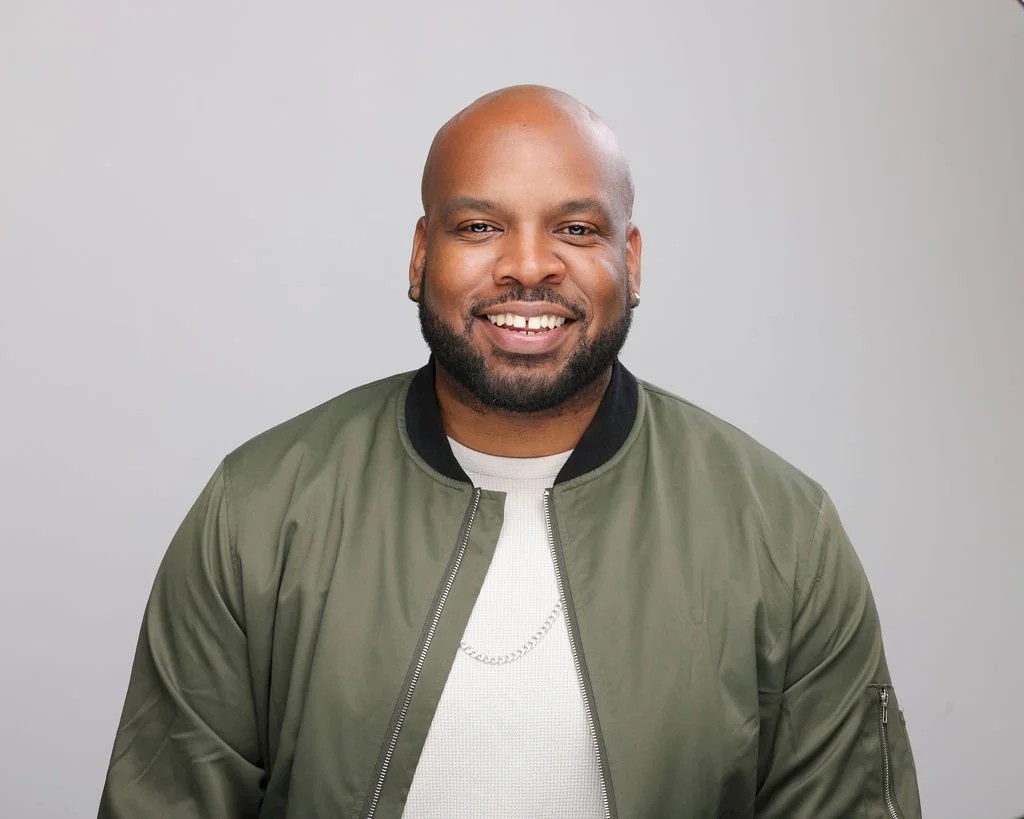
Trey Ferguson is a minister, writer, and speaker, with an MDiv from the Samuel DeWitt Proctor School of Theology at Virginia Union University. His thoughts on faith in an evolving world can be found on the Three Black Men: Theology, Culture, and the World around Us and New Living Treyslation podcasts, in The Son Do Move newsletter, and @pastortrey05 on social media. He lives in South Florida with his wife and three children. Learn more at pastortrey05.com.

Contact
[email protected]
6757 Cascade Road SE, #162
Grand Rapids, MI 49546

As an Amazon Associate and Bookshop.org Affiliate, Lake Drive Books earns from qualifying purchases.