
Buy Now: Bookshop | Amazon | Barnes & Noble | Lake Drive Direct | BooksaMillion | Audible | Apple Books
Table of Contents
A Note from Cynthia
A Note from Danny
Prologue (Cynthia)
DANNY
Dresses and Earrings
Almost Twelve
Labels
Faking It
Megan
Unguarded
Goodbye
Lifelines
Melissa
Marriage
Risk
CYNTHIA
Visitation
Party Lines
Outliers
Tyler
Identity
The Inlet
Panera
The First Night of My New Life
The Boardroom
INTERSECTION
Coming Out (Danny)
Going off the Map (Cynthia)
“What About the Lesbians in the Dorms?” (Cynthia)
Questions (Cynthia)
Free (Danny)
The Net Is Fraying (Cynthia)
Physical Realities (Cynthia)
Severed Connections (Cynthia)
Shopping Mall Academy (Cynthia)
The Wedding (Danny)
Things Worth Toasting (Cynthia)
Epilogue (Cynthia)
Acknowledgments
Notes
About the Author
A Note from Cynthia
The task of writing a nonfiction narrative requires a string of decisions about what to reveal and what to conceal. “Danny,” for instance, is a pseudonym. In a cultural climate where transgender and, by extension, intersex individuals are too often targeted for hate crimes, and out of respect for the new life Danny is building, changing his name was an easy choice. By extension, I was equally opaque about the exact Hampton Roads community in which Danny grew up; thus, names of schools, churches, and the people associated with those places were all changed.
I opted also to protect the identities of people from my childhood—many of whom I haven’t seen in decades—who perhaps would not have wanted to become literary characters. Equally simple was the decision to withhold the name of the university at which I worked. The events that played out could have occurred at dozens, perhaps hundreds, of conservative schools in the country.
In fact, during the writing of this book, I was interviewed for an article in The Chronicle of Higher Education about this very topic: the polarizing impact the legalization of gay marriage has had on Christian institutions. I believe spotlighting my former employer would take focus from the larger story of discrimination against both the LGBTQIA+ community and its allies, which is of infinitely more concern than doxing a single school.
On the other hand, my family and I opted to use our own names, and I chose to identify my current professional home, Christopher Newport University. It is an honor for me to be the face of this project and the keeper of the stories it contains. Additionally, I opted to share identifying details of the Azusa Pacific University story and my interactions with Adam—as he was known at the time—as they were widely covered in the news.
I used real emails, text messages, and journal entries to bolster my memories and made every effort to stay faithful to the details of how events played out. More challenging were decisions about how to portray scenes that happened as many as thirty years ago—scenes I wasn’t present to witness. I drew on over a decade of experience writing human-interest stories to guide my interviews with Danny.
Knowing that encounters with real people are mind-expanding tools, I worked to gather details I hoped would bring Danny to life. The scenes from Danny’s childhood—informed by numerous conversations, photos, and general knowledge of the time period—represent the “movie” my mind constructed of the events, places, and people that comprised memorable moments in his life. I preserved the essence of conversations Danny related to me as faithfully as possible.
Early in the writing process, Danny and I decided to consistently use the masculine form of his name to clearly communicate his life-long self-perception and identification as male. Accordingly, the feminine form, “Dani,” is used only in scenes where he is perceived from an outside point of view, and only during the time period he was presenting as female.
Danny’s story is presented as it was told to me and further informed through years of living in community with Danny, for a time under the same roof. While I am not trained to speak from a medical perspective on the physiology at play in Danny’s account, I can confidently attest that I was faithful to reporting Danny’s story as it was told to me in tandem with my own observations. Danny’s medical facts are complex, facts to which only a highly specialized medical professional could speak to after evaluating Danny, a level of analysis that is beyond the intended scope of this story or Danny’s comfort.
I have my editor, Jessie Stover, to thank for another crucial story decision: the telling of Danny’s story in the first person. I was reluctant to adopt Danny’s “voice”—it felt too personal and invasive. Jessie dragged me kicking and screaming to the place this book ultimately landed: a dual-narrative story told in three first-person sections—and, based on beta reader reactions to the first-person Dani/Danny voice, I am grateful for her pushback to my stubbornness.
A Note from Danny
I am so excited and thankful that Cynthia wanted to tell my story. She has done such an excellent job of recreating my experiences as if she had been there to witness them. I hope that in bringing my story to light, others will identify with my struggles and know they’re not alone.
I also want to help open the eyes of those who may not be familiar with intersex or the LGBTQIA+ community, and for members of the community to know, regardless of your sexual orientation or gender identity, you are beautifully and wonderfully made just the way you are.
Prologue
Cynthia
The lines disappeared from the asphalt as I catapulted into the pitch-black unknown. My heart thumped to the frantic flap of the windshield wipers as my knuckles went white, rigid around the steering wheel. With every brain cell focused on the six inches of pavement I could make out in front of me, I had no mental space to process that I was out this late, in this storm, because the impossible had just happened.
I’d been handed a dream job—one that came with a brand-new dream life. In short, I had been right. Circuiting three universities in two states every week could lead to something. My career wouldn’t cap off teaching out of a Chevy Spark with a trunkful of ungraded papers, a tumbleweed of half-clean clothes and a pile of snack wrappers riding shotgun. A midsemester tenure-track promotion wasn’t something that just happened. Especially to someone two years away from a Master of Fine Arts in creative nonfiction.
It was a rare, aspirational position that had seasoned PhDs scrapping and scrambling for interviews with national search committees. It was something no adjunct instructor ever declined discussing, even after a 7:00 p.m. class at the tail end of a thirteen-hour teaching day. Even with ominous clouds looming in the weather radar report and an hour’s drive ahead, there was nothing to do but stay and listen to the academic dean describe the raise, the office, the job security, the schedule tailored just for me.
Maybe the storm wouldn’t hit before I was past the twelve-mile stretch of unlit, unlined road. Maybe it would never come at all. It didn’t occur to me that driving blind through a storm wasn’t the only threat to my brand-new life. I had no way of knowing the fast pass to the tenure track I’d just scored in the dream job lottery came at a steep cost. It would be days before I’d realize the plan I’d made with Danny the week before was tantamount to jumping the guardrails, and even if I did manage to keep my little Spark on the road, it wouldn't keep my life from derailing.
Danny’s story had put me on a collision course from which there was no turning back. Hearing his story had changed everything.
Danny
Dresses and Earrings
Being a sixth grader with both a penis and a period was confusing, to say the least. But long before my momentous puberty, I was a befuddled toddler at war with a dress. “I don’t like dresses. I am a boy.” I shook my tangled mop in frustration as I pulled a T-shirt and shorts from my drawer. “I want to wear this!”
“Danielle, you’re a girl,” my mother said. “Well, I’ll be a boy when I grow up!” My parents had six children: my older brothers, Rick, Bill, and Jim; my older sisters, Barb and Mary; and me—the child they called their red-haired little girl. Except I wasn’t a girl. True, at that moment my three-year-old body looked like a girl’s body, but I didn’t know that. What I did know was that I seemed to be the victim of a terrible mistake.
In my mind, I was clearly a boy, but everyone kept calling me a girl. How could no one see me? The other thing I was sure of was that I wanted nothing to do with the short, frilly dress my mother, Sherry, was holding. “But the green is so pretty!” My mother sighed in exasperation. Barb and Mary loved dressing up. In fact, my mother had just recently sewn them each new dresses as a final project in a home economics class she took at the local high school.
Finishing the class earned her the diploma she’d forgone twenty years earlier when she left her unstable home at sixteen to marry and move away with a young college student—my father, Ben. I know my mother succeeded in getting me into that dress at least once, because I’m wearing it in a faded 1973 snapshot of our family outside our standard-issue house on the California air force base where we were stationed.
In the photo, Dad stands on one end in a suit and tie with trim, military-regulation hair, my mother alongside him in coiffed curls and earrings. Mary stands next to Mom, her hair long and straight. Next is Barb, the seventeen-year-old beauty queen of the family, sporting a bob and a crisp A-line dress. Then there are the shaggy heads of my brothers, Rick and Bill, poking out from the back row, while Jim stands in the front. Everything about the photo comfortably belongs in that early seventies moment. Everything except me.
I stand next to Jim in a frilly green dress that barely grazes my thighs, thumb jammed in my mouth and a scowl etched on my face. In my mind, I have always been male, and I have always thought of myself in the masculine: as Dani, despite having to spell it with an i. Even as a toddler, I didn’t understand the confusion about my gender, but I also didn’t know how things worked: perhaps I had to grow into my masculinity.
I was frustrated that the world saw me as a girl, but I knew who I was—I would just have to wait for everyone else to see it too. It would be decades before the word intersex became part of my vocabulary. These were years without facts, science, or the internet to help me understand what was happening inside my mind and, eventually, my body. Years full of question marks, fear, shame, guilt, and confusion. Years of knowing that whatever was happening to me wasn’t normal and couldn’t be discussed in our conservative, Christian home.
Because no matter what my mind said—or what changes my body went through—I was expected to be what the world demanded: female. My mother hoped my identification with the masculine was a passing phase. But it didn’t pass. Not at our next station in Guam, where I grew into an active child with an impish smile, occasional black eye, and a tumble of tangled strawberry curls that I hated having touched or brushed.
And it didn’t pass in Virginia, where we moved on humanitarian orders when my mom’s sister was dying of cancer and, exhausted by life events and my incessant pestering, she relented and allowed me to cut my hair—short. Very short. It was a change that ushered in the golden age of my childhood. Despite the stressful circumstances that brought us to Virginia, I settled into life in the close-knit military community that came complete with a self-contained elementary school.
The kids in my neighborhood were a living kaleidoscope: Black, white, Asian—no one cared who you were or where you were from, as long as you were up for a lively game of tag or pickup ball. Playing outside with my friends gave me the opportunity to just be myself. I fell in naturally with the boys in the neighborhood. I never felt detached from male camaraderie, and when it came to games of “house,” the girls always assigned me the role of the dad.
In fact, that’s how I got my first kiss. I was hanging out with a friend one day when his sister, Maggie, came home with another girl and we all decided to play house. I was Maggie’s husband. When the time came for me to go off to “work,” I kissed Maggie on the lips. It wasn’t sexual—it was just normal role-playing. I saw myself as a guy, and they did too. Maybe that was just wishful thinking, but that was my perception at the time.
What didn’t feel normal were the types of things I felt I had to do at home to please my parents. They were constantly steering me toward feminine activities and clothing: skirts were a must at church—Sunday morning and evening. I hated every minute I spent in a skirt, and I knew how much that disappointed my mom. The guilt gnawed at me constantly. I lived for the rare moments when I felt comfortable and my parents were happy too.
Like the time I was six and I somehow ended up with a Happy Days T-shirt. Simple things like that made me feel like myself. One evening when I was wearing it, I bounded into the living room where my parents were holding a Bible study group. “Heyyyyy …” I called in a deep, gravelly voice, two thumbs pointed skyward in my best Arthur Fonzarelli. The room burst into laughter. In that moment, I was the Fonz, and my parents loved it.
Nothing beat the feeling of being seen and appreciated as myself, hamming it up, emulating a masculine role model. The routine became a shtick, a feel-good go-to. In terms of emotional boosts, visits from my maternal grandmother were the anti-Fonz. She didn’t enjoy kids in general. Shooing everyone outside to play was standard procedure during her stays. But my appearance and habits particularly vexed her sensibilities.
Gigi, as she was called, was an Elizabeth Taylor-esque figure in matters of both deportment and matrimony. Tall, thin, and impeccably dressed in pantsuits and jewelry, Gigi had been divorced four times before the 1960s. By the time I came along, she’d settled into permanent union with Milton, a professional musician who had earned a place in the New Orleans Jazz Museum.
Milton was the sole embodiment of anything good that happened to me during our visits, whether at Milton and Gigi’s house in Florida or at home in Virginia. “Don’t touch!” Gigi would say at intervals whenever the kids were in her home. “Kids need to be kids outside,” was another of Gigi’s mottos. “If you are going to sit inside, you’re going to behave. In here, it’s adult time.”
Adult time was of no interest to me; I preferred to ride Milton’s bike outside all day. But adult time occasionally moved outdoors when it came to waterskiing or golf, two of Gigi’s pastimes. During one Florida visit, Gigi dropped my siblings and me off at Epcot Center for the day so the adults could play golf and head to the country club for dinner and dancing.
My dad told me later how bitter he’d been about the whole thing; he wished Gigi had dropped him off at Epcot Center too. When I wasn’t pedaling around the neighborhood on Milton’s bike or being shuttled off to an amusement park, I typically rode out our visits with Gigi in the company of Milton and Dad, watching TV and picking up guitar tips from Milton while the women shopped and lunched.
Hiding out with Milton was a place of refuge, a sanctuary of sorts that came to a sudden and certain end when Gigi and Milton visited Virginia right before my tenth birthday. Mom would always go into overdrive on these visits, putting extra effort into “fixing” me in an attempt to gain her mother’s approval. Gigi would shake her head and frown at my mother as soon as she saw me. “She is too dirty for a girl! Look at her hair! It’s a mess. She’s never dressed.”
Mom would turn to me. “You have to act like a lady,” she would say, reinforcing her expectations with a continual string of corrections: “That’s not how young ladies sit,” or speak, or act. But this visit was different. I was suddenly required to take part in the shopping and lunching excursions, no longer allowed to hang out around the TV with Milton and Dad. Then came the day Mom told me to get ready to go to the mall.
“Gigi is doing something special for your birthday today!” Mom sounded thrilled, but I wasn’t fooled. I knew there was no way this could be a good thing. “We’re going to take you to get your ears pierced!” “What?” I immediately panicked. How could I get out of this? “No, please!” I was desperate and begging. “I don’t want that.” “Listen,” Mom said. “This is something Gigi wants to do for your birthday. You are going to do it. It means you are growing up.” Her voice lightened. “You’re becoming a woman!”
“That’s so unfair!” Mary said when she heard the plans for the shopping trip. “The rest of us had to wait until we were sixteen to get our ears pierced! It was the rule!” But normal rules were prone to be abandoned in extreme circumstances, and it seemed that Gigi had declared my state to be one of utter emergency. I’m sure I looked like a prisoner condemned to the gallows as I trudged through the mall.
“How long do I have to keep them in?” I asked Mary. “Just wear them when Gigi comes.” But my worries were more immediate. “I mean, how long in the beginning?” “Six, maybe eight weeks.” My stomach sank. Dad and Jim’s church softball teams were about to begin exhibition games. I waited for softball season all winter. Not only did I love to be on the softball field, but playing with the kids of the opposing teams’ players gave me a chance to interact with peers who didn’t know to call me “her,” or that I wore skirts on Sundays and had to be reminded to act “like a young lady.”
Like a rancher’s brand on a cow’s hide, the earrings would be a mark of identity. The shiny studs would instantly label me as something I wasn’t: female. I sat in a chair in a raised booth that seemed to be in full view of the mall shoppers. I felt like a spectacle. A saleswoman showed me a display of earrings and asked me which ones I wanted. In what amounted to a last stand, I pointed at one of the men’s earrings.
“Oh no,” the woman said, laughing. “Those are for men. They don’t come in pairs. You need to choose from these,” she said, sweeping a hand across several rows of shiny studs. I chose the tiniest cubic zirconia setting available, pinning my hopes on the possibility that the small specks could be overlooked. Resignation washed over me once the studs were through my ears.
But a small bit of hope resurged as the woman explained the importance of cleaning my ears each day and underscored the risk of contamination. I silently pledged to never clean my ears and hoped that germs would accumulate into a raging infection. Much to my eventual disappointment, my ears were impervious to toxins despite my meticulous neglect.
The earrings became just another thing I endured for the sake of keeping my home life as normal as possible—a challenge that would become increasingly difficult now that I’d reached my double-digit years. Indeed, my carefree days of playing and learning within the familiar confines of the air force base were drawing to a close. Dad’s retirement was approaching, and we would need to adjust to life outside the supportive structure of the Department of Defense. Even though we would be settling into a home just a few miles off base, for me the move was a permanent transition from childhood into the pressure of a larger public school—and a puberty no curriculum could have possibly prepared me for.
Cynthia
Visitation
The burlap sacks stood in clusters on the side of the gravel road, a spindly stick protruding from each bundle. Fruit trees, we’d been told. Ken crouched next to a clump of burlap bags, reaching for one of the sticks. “Mango?” “I don’t know, Ken. I still don’t think they need trees. Look around—fruit trees everywhere!”
“It’s not about the trees.” He shook his head and chuckled in a tone I interpreted as pity. “It’s about relationships.” I’d already had this conversation with Ken—the American team leader from the organization our university was traveling with—so I knew what was coming: something about getting out in the community, making friends. Which was fine. What I wasn’t sold on was the ulterior motive: foisting ourselves on people so we could ask about their problems and then bow our heads in prayerful supplication on the spot.
It was awkward—intrusive. Ken was unmoved, and there was no getting out of the tree distribution, no chance of being reassigned to the kitchen, to the garden, the library—anywhere there might be a better chance of meeting people in the community and allowing natural, authentic connections to form. I threw back the last of my coffee—a dark, hand-ground brew as uniquely Haitian as the locals who pan-roasted the raw beans in fresh cane sugar—and joined my son, Brandon, and our university’s student-life director, Allie.
We walked down the gravel road with several Haitians from the local church our university had partnered with. I pictured a team of strangers showing up at my door back in Virginia offering random vegetation and light chitchat as a gateway to impromptu prayer, and I just wasn’t convinced we had a solid plan for a relationship icebreaker. It seemed exactly the type of do-gooding I’d seen from well-meaning church people every time I’d been to Haiti.
I hadn’t been immune to it myself on my first trip a few years prior. I fell hard for Haiti on that visit. Minutes after our turbo prop plane touched down on an expanse of brown soil, I was bumping down a winding dirt road in the back of a military-grade truck and burst into laughter. No one had been happy I’d gone, that first summer. People reminded me that I was taking my son to the most impoverished place in the western hemisphere, a place steeped in voodoo, disease, and danger.
But as I took in vivid fuchsia flowers, fabrics on wash lines, faces turning upward as we rolled past, something grabbed me: it was love at first sight. I was hopelessly smitten. I watched the Haitians watch us as we lumbered by in a billowy haze of dust. I knew they called us the blancs: the whites, but they loved us, right? We were here with tools, supplies, and open arms. We had resources, solutions. We were here to help.
An hour later my son and I were in a large, airy room with bunk beds, cribs, and toys, shoulder deep in toddlers—shrieking, giggling toddlers welcoming us to the orphanage they called home. An orphanage we were there to help expand. Somewhere in a tangle of hugs and a game of tag, I became a cliché: a white woman who wanted to take a baby home. What would it take, I wondered, to pluck one of these tots from this orphanage and take them into my family—my white, American, middle-class family?
When I casually asked about the adoption process, the answer came as a smackdown to my assumption that giving these kids a “better life” in America was even a goal. “Oh, no,” one of the Haitian orphanage mothers said. “This is their home. We’re here to love them and teach them how to become good Haitians.”
From that moment on, assumptions fell like dominos. I was surrounded by beauty, but also hard truths. I began to question everything—even the way we packed. At our informational session we’d been told to bring clothes we didn’t care about—not just because we’d be working but because we should consider leaving everything behind—even our suitcases if we could manage it. Our castoffs were billed as valuable resources.
Leaving our sweaty work clothes behind represented even more good we could do on our trip. While every scrap of clothing left on Haitian soil is worn and appreciated, I know now it is a problematic truth. Once Americans began treating Haiti as a dumping ground for used, misprinted, surplus clothes, the Haitian clothing industry buckled—resigning a country of people to wardrobes touting slogans they can’t read, products they don’t have, and events neither they nor anyone else had ever been to. Bach Week 2010, anyone?
And then there’s the matter of “generous” gifts. On the orphanage expansion building site some American team members noticed a group of Haitian men beginning day three of moving a pile of dirt with buckets. “What do you guys think it would take to purchase a bulldozer for the mission?” one of the men in our group said. Several guys started talking money and availability when someone from the mission spoke up. “No. Bad idea. Do you know how the community would see a bulldozer?” The men’s eyes narrowed in confusion. “Lost jobs.”
I listened as the American with a Haitian address delivered another smackdown. “Those men over there have earned three days’ wages thanks to that dirt pile. We can’t tamper with their economy. And something goes wrong with the bulldozer? Where would they get it fixed?” And then, in perhaps the most damning indictment of all Christian proselytizing efforts, I met Haitians who traveled on a mission trip of their own to America—because they saw us as spiritually impoverished.
I didn’t know it then, on my first trip, but I was there more to be helped than to help. Washing off the first layer of workday grime in the turquoise water every afternoon, holding tiny Black hands, sipping fresh-squeezed juice that tasted of heaven—I romanticized Haiti. So much that I returned four more times with my son, traveling all over a country I adored. I was happy to be a part of some activities that seemed like true partnerships between Haitians and Americans, and, along the way, I thought I had become pretty adept at spotting ill-informed and misguided attempts at well-doing.
Now, this prayer pop-in with the stick trees seemed like another attempt to awkwardly insert ourselves into the lives of people we hadn’t taken the time to fully understand. So we proceeded to interrupt a family doing dishes in their outdoor kitchen. We talked with a couple old men who seemed pleased to have the company. And then we arrived at the home of a young woman. She was sitting on her earthen floor doing some sort of chore, perhaps peeling vegetables.
Someone introduced her as the wife of someone or other in the Haitian church. She politely accepted the tree, but there was a look around her eyes, a certain weariness. Someone asked how they could pray for her, and she paused for a moment before answering in Creole. Our interpreter turned to us. “She would like you all to pray that she could somehow start to like going to church.”
Had I still been drinking my hand-ground coffee, I would have spewed it mid-swallow. It was all I could do to keep a straight face. Church was something you took in because it was good for you, like V8 or collard greens. Church wasn’t meant to be liked. Sure, there were people who pretended to enjoy church, much in the way one feigns enjoyment of opera or dense classics—but truly liking church, week in and week out, in perpetuity? It just didn’t happen.
“Good luck,” I murmured under my breath. Brandon and I exchanged glances. I bit my lip and bowed my head. It was that moment I realized the visit wasn’t just another example of do-gooding Americans getting it wrong—it was her church that had sent us to her specifically. This wasn’t another half-baked American initiative: this was church being church as I had always known it.
Even Haiti wasn’t immune to doing dumb things in the name of ministry. The hard truth was we’d been sent here on visitation. I remembered visitation from my childhood churches, some of which reserved a whole evening every week for sending Bible-toting squads to the homes of people in need of “encouragement.” Sometimes they came bearing cookies or random flora; most of the time they had nothing to offer but judgment.
Being the subject of visitation was invariably bad. One was at risk of visitation for a wide range of reasons: spotty attendance, rumored bad habits, and suspect doctrine were common. My own family was once the target of a church visitation effort, but I was too young to spot the signs. I remembered the day well. One spring evening when I was about nine, my mother bolted from the kitchen table and told us to hide.
My little sister, Emmie, and I scrambled up the stairs to our bedrooms—two large, adjoined rooms that comprised the entirety of our home’s second floor. I slid under my bed, but my window, six inches from the floor, afforded me full view of the street and front yard. I saw a couple of older folks from church exit their car and amble down the front walk. I identified a portly woman who had once announced that she had no sense of smell—making her, in my mind, something akin to a sideshow curiosity.
We were called out of hiding moments later. Mom looked as if she’d sent a squadron of enemy troops into retreat, but when we asked her why we were hiding from the church people, she was evasive. “Oh, I just didn’t want visitors with your father away,” she said, attempting to shoo off the discussion. Our father was on a two-week trip to Singapore with the Gideons, the organization behind every Bible currently resting in a hotel nightstand.
My mother may have won the battle, but the persistence of the church people was not to be underestimated. They would return a few days later, and she would let them in. It wasn’t until my father was back in our kitchen that I learned the reason for the visit. “Who does such a thing?” he fumed, pounding a fist on the table. “Who makes a special trip to someone’s house just to say they aren’t praying for them?”
It seemed the church leaders came by to explain that my father’s wanton distribution of scripture was not condoned. His time, effort, and money needed to be filtered through their approval, their leadership. His trip with the Gideons was in flagrant disregard of their counsel, and they wanted to send a clear message: their prayers were not with him in Singapore, or with my mother on the home front.
Our family was operating in a void of prayer support, and my mother needed to know. Although it would be accurate to say that I grew up in the church, the singular here implies a neatly constructed unity that doesn’t remotely describe my experience going to churches, plural. My childhood was a veritable kaleidoscope of religious expression.
I was eight years old when my father—an alumnus of 1960s-era peace and love and dabbler in 1970s Transcendental Meditation—discovered Christianity during a televised Billy Graham crusade. From the moment he turned the dial of the black-and-white, rabbit-eared TV to the off position, I became well versed in multiple approaches to scripture: Methodist, Bible, Bible Baptist, Charismatic, Presbyterian, Plain-Old Baptist.
Most protestant thought would enjoy a period of veneration in our home—but never Catholicism, which was verboten for reasons that were never clear. No matter what church we attended, a pendulum of faith regulated our daily activities and decisions. The weight bobbed rhythmically back and forth for varying periods before taking wild and often erratic swings from the left to the right on either individual topics or entire denominational platforms.
The first church I really remember was a little clapboard affair in the hills of the New York Southern Tier, where we moved after my father became disillusioned with his mercurial career in commercial radio and abandoned a lucrative contract with a station in Cleveland, Ohio, to join my grandparents at the family spinning mill. My parents, George and Margaret, bought a crumbling farmhouse at the intersection of a narrow gravel road and paved street.
My parents were deep in a Thoreau-esque quest for authentic experience, in search of the kind of bounty that city life couldn’t offer: a garden, fresh-baked pies plump with wild berries, forts and tree swings. Enter Billy Graham, a handful of starter churches, and then the little congregation of farmers who filed into polished pews at the Locust Hill Bible Church each week to sing from hardbound hymnals with threadbare covers.
I can still travel the route in my mind: an ascent up the dirt road across from the house, a right-hand turn onto another dirt road midway up the hill, some twists and bends, and the simple white building nestled amid verdant cow pastures. The church became our community, our home base. Sunday services and Wednesday prayer meetings were weekly touchstones—safe and familiar. Church life was an extension of family life and mirrored it in many ways.
One Saturday afternoon each month, we piled into the family car for our turn cleaning the church building. My mom would head to the kitchen, Dad would navigate a vacuum or lawnmower, and I’d head to the sanctuary to dust the hardwood pews while Emmie played. There’s no chance I was a thorough duster, as most of my memories in the empty sanctuary are of running up and down the aisles or taking in the view from behind the pulpit—things I wasn't allowed to do when adults were present.
But church wasn’t all work—it was where you found your friends. Pastor Blessing and his wife were just a bit older than my parents, and their daughters, Juliana and Sadie, were about my age. Since my family was almost as involved in church life as the pastor’s clan, our families became fast friends. Dinner at each other’s homes would invariably end with three voices begging for permission to sleep over.
But this simple time in the little country church ended in scandal when Pastor Blessing and his family began speaking in tongues, a practice that involved the involuntary utterance of unknown languages. Although the story about “tongues of fire” being conferred on early Christians came straight from Acts chapter two in the Bible, I heard adults describe the practice as “not for today” in a tone that conveyed that dabbling in the “dark art” of tongues represented more than a spiritual quirk, but, rather, crossing a line of demarcation.
Even as a child, I instinctively understood the power of lines. I also knew lines as boundaries—my father’s finger drawing invisible fences around our property, indicating the separation between protection and the unknown, where I belonged and where I didn’t. Lines told stories: where things began, where they ended, what was included, and what wasn't. And if there was anything I liked better than art, it was a story.
This story of why I could no longer play with Juliana and Sadie, why we’d never again drive those twisty roads to sit in those hard, polished pews, seemed disconnected with the lessons of love I learned inside those walls. This story was my first glimpse into what happened when someone ventured beyond established boundaries and into the space outside the lines. Lesson: communities cannot disagree.
Soon we were attending a new, bigger church with more opportunities. My sister and I joined Awana, a kind of spiritual scouting program. To this day I attribute most of my Bible knowledge to my efforts to earn scripture memory badges during weekly club meetings. In Awana, right answers were a currency that garnered applause and awards. As a gangly, bookish kid on the periphery of the elementary school social scene, I craved the accolades.
My Awana leaders held the status of mini celebrities in my life. Likewise, club for me was a lifestyle rather than an event. My church connections and projects kept me grounded and focused; they gave me a sense of purpose. Our family settled in at the Bible Baptist church for some time. I worked my way through several Awana ranks, and my dad took over the teen boys’ Sunday school class. Our house became a second home for some of the boys, giving Emmie and me a cadre of surrogate brothers.
I would hear rumblings of incidents that rankled my parents’ sense of justice: the young newcomer who was asked to leave because he’d entered the sanctuary with a guitar, my father’s dwindling favor with church leadership for befriending a local mink farmer who’d been marginalized for mysterious infractions, and their general disapproval of my father’s involvement with the Gideons.
I was eleven when we left the Bible Baptist church. I do remember the event that signaled the next major swing of our pendulum of faith. Late one night, I tiptoed into the kitchen for a drink and found my father leaning against the tall coal furnace in the back of the room, head bowed, hands clasped, fervently muttering incomprehensible phrases. I paused for a moment, listening to be sure. Tongues!
I quietly retreated back upstairs, deciding to remain silent and await further developments. Eliminating the concept that tongues was a great evil seemed to expand my world. My father had crossed the same line Pastor Blessing had years earlier, and here we were on the other side of that breached boundary. And nothing had shattered. In fact, things seemed more complete.
The shift signaled the return of the Blessing family, with whom we began enjoying meals and friendship once again. New people with kids my age began coming to the house. Sometimes we even went to Charismatic church, where everyone spoke in tongues. “It’s a prayer language,” Juliana said one evening. “It’s a gift from God that helps you pray better because you are speaking God’s own language.” God’s own language! How exciting! I wanted in.
“How do you do it?” I asked. “You pray that God will give it to you,” Juliana said. I squeezed my eyes closed and sat in silence while she prayed for me. I waited. Nothing. “Maybe you need to get a pastor to pray for you,” Juliana said. So next time I went to Charismatic church, I crept down the aisle and asked the pastor to lay hands on me. He petitioned the Lord with fervor on my behalf for several minutes before encouraging me to “say whatever came to mind.”
At one point, I mumbled some convincing syllables, but I felt silly, fraudulent, and warm with shame. If the gift of tongues was a thing, I wasn't getting it. But I wasn't alone. My mother didn’t like Charismatic church and didn’t get the gift either. Our trips to Charismatic church became less frequent, and eventually stopped altogether. The Blessings and our new friends faded from our lives. Lesson: people leave if you disagree.
Our next church was a small Presbyterian congregation situated on the main street of a neighboring town. The pastor, Reverend Carson, was a gentle, soft-spoken man who devoted hours each week to the youth. Reverend Carson’s Christianity seemed to draw lines of connection rather than boundary—inclusion as opposed to exclusion. His spirituality included cross-faith dialogue, social justice, and activism.
But a border line still divided my construct of faith. Perhaps to counterbalance the more liberal mindset that prevailed at church, my father adopted stringent standards at home, particularly in terms of what we were allowed to watch and listen to. He occasionally objected even to movies that Reverend Carson took us to see, such as Gandhi. I frequently felt guilty for thriving at church but covertly gorging on contraband at home. Lesson: I don’t agree with people I care about—and that is dangerous.
My time at the Presbyterian church was cut tragically short when my father and grandfather were forced to shutter the family spinning mill. He decided to return to broadcasting at a Christian radio station hours away from the farmhouse. After the move my father was contractually obligated to attend the nondescript, straitlaced, fundamental Baptist church whose Sunday service aired live on the station.
My own spiritual investigation was just beginning. I simply couldn't miss the message that inclusion depended on conformity. Someone can be a cherished member of an all-consuming “family” one Sunday and excommunicated the next. But in a way, observing shoddy Christianity ultimately managed to do more to strengthen my faith than squelch it. My idea of God kept getting bigger with each failed attempt I saw to contain him.
It was against this checkered backdrop that I evaluated my adult experiences with organized Christianity. I’d love to have another ten minutes to have a real conversation with that young Haitian woman. I’d pop a squat beside her on the earthen floor and say, “You know what? Chances are, you’re never going to like church, and that’s okay. I’m not sure God likes church much either, and that means you just might have a better chance finding him out here than in there.”
But those fleeting moments I did have in her home came before my spiritual life and then my inner world burned to the ground—yet long after I took my turn at being part of the problem.
Acknowledgments
This book is only possible because of my friend Danny’s willingness to spend countless hours in honest, transparent, and, at times, painful reflection of some of the darkest moments of his life. The time he spent reliving his past was a selfless gift offered in hope of a more accepting future. May his story be read as a gift, accepted in love, and considered a call to action.
I am grateful to my family, who allowed me to turn them into literary characters. I especially want to thank my husband, Brad, who, next to Danny, is the person most responsible for what follows—from the initial idea through every rewrite and the long path to publication; his influence is on each and every page.
I would be remiss not to acknowledge my father, George, for modeling faith as an evolving process and for fully supporting not only this book but where I am in my spiritual journey. Thank you, Dad, for your continued affirmation of me and my work. Thank you, Krista, for entering the story in medias res and not only tolerating it but embracing the project and all that came with it—and becoming family along the way.
Thanks also to my friends Lisa, Caroline, Patti, Tracy, Reese, Melissa, Lily; my sister, Emmie; and my friends in the Quarantine Writers Club for cheering me on through every step of this process. Thank you to my Sisters of Perpetual Disorder, Virginia and Anna, for becoming my work community, my colleagues, and—most importantly—treasured friends.
Thank you to Kerry for going through the MFA and post-grad publishing adventure alongside me. Your book is next! I am appreciative to Joe Jackson, whose stint as a visiting writer at Old Dominion University happily coincided with the second—and better—half of my MFA work. Joe’s hard-hitting commentary, evening round tables at Stella’s with Kerry, and belief in my story shaped my early iterations of Intersexion.
I also wish to acknowledge Kathy Ver Eecke and the Pitch to Published community for teaching me how to pitch my work and for connecting me to my editor, Jessie Stover, who worked with me to shape my manuscript into a polished final project. And finally, thank you, David Morris, for seeing the potential in my book and in my writing career. Thank you for giving this project such careful attention, bringing in a top-notch support team, and assigning me the incomparable Jenn McNeil as my copy editor.
About the Author
Cynthia Vacca Davis teaches narrative nonfiction and journalism at Christopher Newport University. She holds an MFA in creative nonfiction and has led nonfiction workshops at The Muse Writers Center in Norfolk, Virginia, one of the biggest community writing centers of its kind in the country. She’s written hundreds of feature stories and profiles, a handful of pieces for literary journals, and two independently published YA novels, The Chrysalis and Drink the Rain.
When she’s not home in coastal Virginia with her husband, pets, and students, she can often be found in the French Quarter of New Orleans in search of jazz and parades. A connoisseur of beverages, she loves to share a cup of just about anything around a table full of friends. Subscribe to her newsletter at cynthiavaccadavis.com or follow her on Twitter @_cynthiadavis and Instagram @cynthia_vacca_davis.
Buy Now: Bookshop | Amazon | Barnes & Noble | Lake Drive Direct | BooksaMillion | Audible | Apple Books
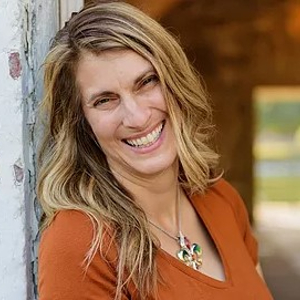
Cynthia Vacca Davis is Director of Journalism at Christopher Newport University. She holds an MFA in creative nonfiction, leads workshops, has written hundreds of regional feature stories, is a writer for Baptist News Global and her local NPR. Cynthia is the author of Intersexion: A Story of Faith, Identity, and Authenticity and has two independently published young adult novels, The Chrysalis and Drink the Rain. When she’s not home in coastal VA with her husband, pets, and students, she can often be found French Quarter of New Orleans in search of jazz and parades. Subscribe to her newsletter or follow her on social media at cynthiavaccadavis.com.

Contact
[email protected]
6757 Cascade Road SE, #162
Grand Rapids, MI 49546

As an Amazon Associate and Bookshop.org Affiliate, Lake Drive Books earns from qualifying purchases.